

The Anatomy of a Dirty Flame Sensor and Why It Halts Your Heat
The 3-Second Shutdown: When Your Furnace Quits Just As It Starts
You wake up to a chilly house, walk over to the thermostat, and bump up the temperature. Down the hall, you hear the familiar sequence: the draft inducer motor hums, the gas valve clicks open, and the burners roar to life. But before you can even feel the warm air reach your vents, everything goes dead silent. The anatomy of a dirty flame sensor and why it halts your heat is a mystery to most homeowners, but it is one of the most common reasons your furnace shuts down immediately after starting.
This frustrating cycle—starting, igniting, and abruptly turning off—is enough to cause immediate anxiety, especially during sudden November cold snaps. In our years of providing heating solutions to Battle Creek MI, our team at Hodgson Heating & Cooling has seen firsthand how a sudden loss of heat upgrades from a mild nuisance to an urgent home comfort emergency—especially right as families are prepping for the holiday season. The temperature inside your living room can plummet in a matter of hours, leaving your family shivering and scrambling for extra blankets.
Here is the surprising truth: when your furnace exhibits this specific three-second shutdown, you are rarely dealing with a catastrophic system failure. Your blower motor is likely fine. Your heat exchanger is probably intact. Instead, the culprit is usually a microscopic issue triggering a highly sensitive, built-in safety mechanism. A single, tiny component governs the entire heating cycle, and when it gets slightly dirty, it brings the whole operation to a grinding halt.
To understand why this happens and how to fix it, we have to look inside the burner compartment. Keeping your heating systems running reliably through a harsh winter requires knowing how these small safety devices operate, why they fail, and what it takes to restore your home's warmth.
What Is a Flame Sensor and What Exactly Does It Do?
Before you can understand why your furnace is shutting down, you need to know what a flame sensor actually is. If you were to open the front panel of your furnace and look at the burner assembly, you would see a very simple-looking device positioned directly in the path of the flames. It consists of a thin metallic rod, usually bent at a slight angle, anchored by a small white ceramic base.
Despite its unassuming appearance, this metal rod is the most critical safety monitor in your entire heating system. Its primary job is to prove to the main control board that a flame actually exists once the gas valve opens. Without this confirmation, your furnace is essentially operating blind.
The Science of Flame Rectification
The flame sensor does not measure heat. It does not measure light. Instead, it measures electricity using a fascinating process called flame rectification. Here is how it works:
• The electrical charge: The furnace control board sends a continuous, very low AC electrical voltage to the metal rod.
• The conductive flame: When the gas burners ignite, the fire itself acts as a conductor. The flame envelops the metal rod.
• The current conversion: The fire converts the AC voltage into a tiny direct current (DC). This current travels through the flame, grounds out on the metal burner assembly, and completes the circuit.
• The microamp reading: The control board registers this completed circuit as a specific measurement—typically between 1 and 10 DC microamps.
A microamp is one-millionth of an ampere. It is an incredibly tiny, fragile electrical current. If the control board detects this microamp current, it knows for an absolute fact that a fire is burning safely inside the heat exchanger. It then allows the gas valve to stay open and signals the blower motor to start distributing warm air through your home.
Because this process relies on such a delicate electrical current, any interference will break the circuit. When that happens, you find yourself needing furnace repair in Battle Creek to restore the system's ability to "see" the flame.
The Microscopic Mechanics: How Carbon Buildup Happens
If the flame sensor is just a solid metal rod, why does it stop working? The answer lies in the natural byproducts of the combustion process. Even in a well-maintained furnace burning clean natural gas or propane, the act of creating fire produces trace amounts of airborne particles.
The Daily Wear and Tear of Combustion
Every time your furnace kicks on, the metal rod is engulfed in a roaring flame. Over weeks, months, and years of operation, this intense environment takes a toll. The continuous burning naturally creates byproducts like trace carbon, soot, and oxidation. Because the metal rod is sitting directly in the fire, these byproducts slowly bake onto its surface.
The problem: This creates a microscopic layer of carbon on the outside of the rod. To the naked eye, a dirty flame sensor might not look dirty at all. It might just look slightly dull, gray, or tarnished. But on a microscopic level, that layer of carbon acts as a highly effective electrical insulator.
Breaking the Electrical Circuit
Remember that the furnace relies on a tiny electrical current of 1 to 10 DC microamps traveling from the rod, through the fire, to the ground. Electricity struggles to pass through insulators. As the microscopic layer of carbon thickens, it creates a barrier between the metal rod and the flame.
The cause: The electrical current becomes weaker and weaker. Eventually, the insulation is so thick that the microamp current cannot pass through the carbon barrier into the fire. The circuit is broken.
The solution: It is crucial to understand that in our experience, the sensor itself has rarely "failed" or broken in these cases. The metal rod is still intact, and the ceramic base is still solid. The sensor is simply blinded by the carbon buildup. Removing that microscopic layer restores the electrical pathway and allows the furnace to operate normally again.
The Safety Lockout: Why Your Heat Halts Automatically
When you are shivering in your living room, a furnace that turns itself off feels like a massive malfunction. In reality, it is a life-saving safety feature operating exactly as designed. To appreciate why the system halts, you have to consider the alternative.
If the gas valve opens and releases highly combustible natural gas into your home, but the burners fail to ignite—or if the flame blows out—that raw gas has to go somewhere. Without a safety mechanism, the furnace would continue pumping raw gas into your ductwork and your living spaces, creating an extreme explosion hazard.
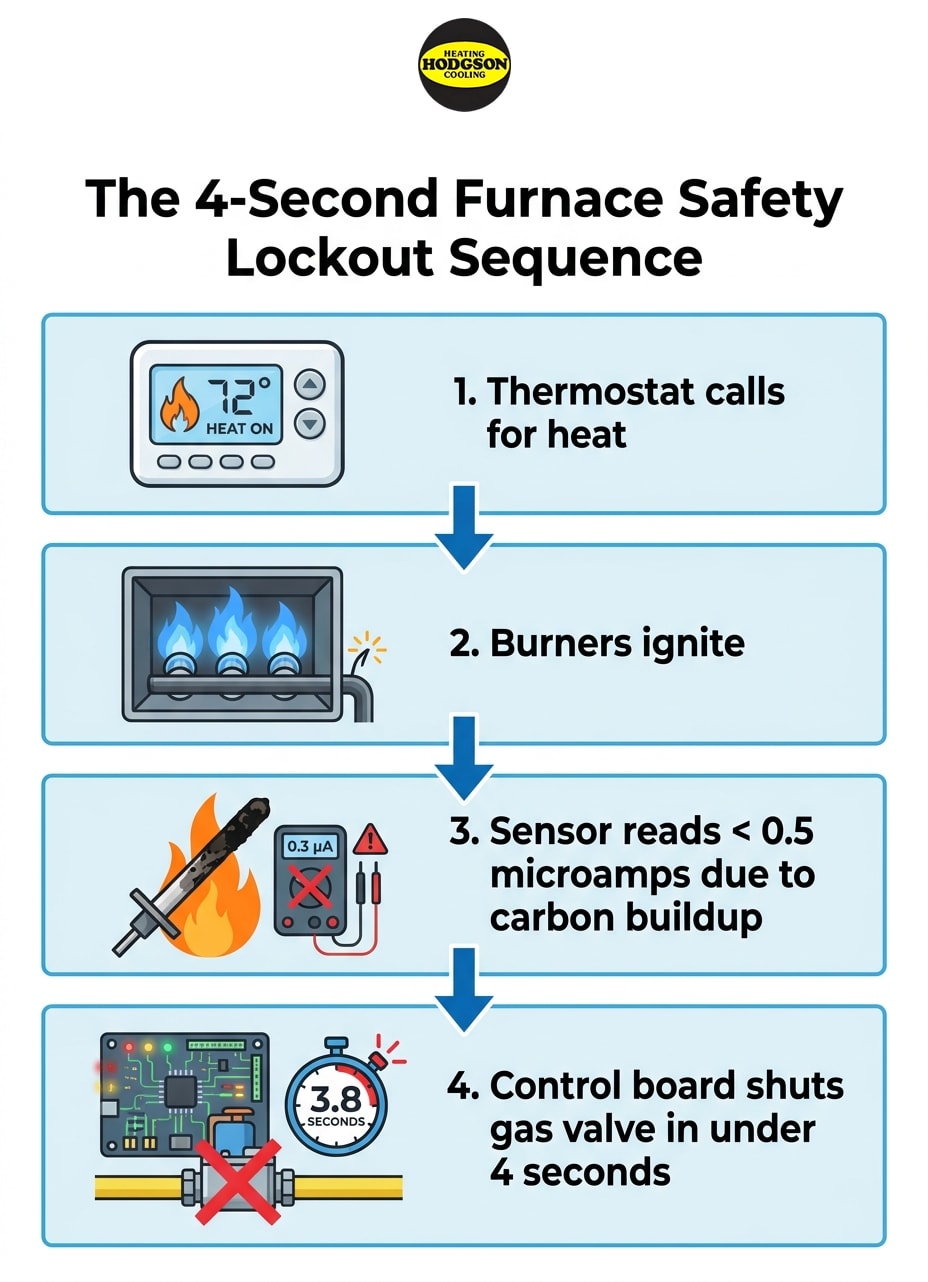
The 4-Second Shutdown Sequence
To prevent this, manufacturers designed the control board to react with lightning speed. Here is the exact sequence of events during a sensor failure:
1. The call for heat: The thermostat signals the furnace to start.
2. Ignition: The gas valve opens, and the burners light successfully.
3. The measurement: The control board monitors the flame sensor for the DC microamp current.
4. The threshold drop: Because of the carbon buildup, the sensor reading drops below the critical threshold of 0.5 microamps.
5. The immediate shutdown: The control board assumes the flame has blown out. It slams the gas valve shut in under 4 seconds to prevent unburned gas from escaping.
This rapid shutdown protects your household. However, the furnace will usually try this sequence two or three more times. If it fails to detect the flame after multiple attempts, the control board initiates a "hard lockout." A hard lockout shuts down the entire heating system for a set period—usually an hour or more—and flashes a diagnostic error code.
Resetting your thermostat or flipping the breaker might temporarily clear the error code, but it will not remove the carbon from the sensor. The furnace will simply repeat the cycle and lock out again. Complex furnace issues can sometimes mimic these safety shutdowns. For example, during a recent pre-winter cold snap, our technicians at Hodgson Heating & Cooling encountered a persistent furnace issue that initially stumped the homeowners because the lockouts were intermittent. By taking the time to check every component, our team was able to order the right parts and resolve the complex problem fairly. Understanding what happens when your furnace locks out is the first step toward getting the right professional help.
Diagnosing the Issue: Ignitor Failure vs. Dirty Sensor
Because modern furnaces happen in a closed box, it can be difficult for a homeowner to know exactly which component is failing. Two of the most common ignition issues are a failed ignitor and a dirty flame sensor. While they both result in a cold house, they exhibit very different symptoms.
A hot surface ignitor is the component that actually lights the gas (acting like a spark plug or a glowing match). The flame sensor merely watches the fire after it is lit. Knowing the difference between the two can help you communicate clearly with your technician.
• Visual Signs — Hot Surface Ignitor Failure: No orange glow; no flames ever appear. — Dirty Flame Sensor: Flames ignite fully and look normal for a few seconds.
• Timing of Shutdown — Hot Surface Ignitor Failure: System runs the draft motor, clicks, then shuts down without lighting. — Dirty Flame Sensor: System lights the fire, runs for 3 to 4 seconds, then abruptly shuts off the flames.
• System Cycling — Hot Surface Ignitor Failure: Furnace may try to light a few times, then stays off. — Dirty Flame Sensor: Furnace exhibits "short cycling"—repeatedly lighting and dying in rapid succession.
• Root Cause — Hot Surface Ignitor Failure: The ignitor has cracked or burned out completely. — Dirty Flame Sensor: A microscopic layer of carbon is blocking the microamp current.
The hallmark of a sensor issue: Short cycling is the most obvious giveaway. If you hear the "whoosh" of the flames catching, followed almost immediately by a click and silence, you are likely dealing with a sensor problem.
However, visual inspections are rarely enough. Because the carbon layer is often invisible to the naked eye, you cannot simply look at the rod and declare it clean or dirty. Properly identifying the root cause requires specialized tools and comprehensive furnace services to ensure the system is operating safely.
Why DIY Cleaning Is a Risky Gamble
When homeowners learn that the root cause of their freezing house is just a dirty metal rod, the temptation to fix it themselves is strong. A quick online search will often yield dozens of forums suggesting you pull the sensor out and scrub it down. However, as heating professionals, we strongly advise against this. DIY cleaning is a risky gamble that often leads to more expensive repairs down the line.
The Danger of Improper Materials
The most common mistake homeowners make is using sandpaper or heavy abrasives to clean the rod. While sandpaper will certainly remove the carbon, it also scores the soft metal of the sensor. These microscopic scratches and grooves create a rough surface texture.
When you put a scratched sensor back into the fire, those tiny grooves act like traps, catching carbon and oxidation much faster than a smooth rod. Our technicians frequently see the aftermath of these DIY attempts: a sensor cleaned with sandpaper might work for a few weeks, but it will foul up again rapidly, leaving you stranded in the cold a second time.
Fragile Components and Guesswork
Furthermore, the metal rod is anchored in a small porcelain or ceramic base. This base isolates the electrical current from the metal body of the furnace. Ceramic is incredibly fragile. Rough handling, over-tightening the mounting screw, or dropping the sensor can easily crack the base. Once the ceramic is cracked, the electrical current will ground out before it ever reaches the flame, permanently ruining the sensor.
Most importantly, without proper diagnostic tools, a homeowner is just guessing. At Hodgson Heating & Cooling, our team utilizes precise diagnostic capabilities on every service call. We use specialized multimeters designed to read DC microamps in real-time. By measuring the exact electrical current before and after cleaning, our technicians prove the exact issue without guesswork. You will know for a fact that the sensor is reading above the safe operational threshold, ensuring the furnace won't lock out again in the middle of the night.
Restoring Your Home's Comfort Safely and Accurately
When you call a professional to address a short-cycling furnace, the resolution process is swift, safe, and backed by data. A trained technician will carefully remove the sensor, ensuring the ceramic base remains intact. They will then clean the metal rod using specialized, non-abrasive materials—such as ultra-fine wire mesh or specially designed synthetic pads—that remove the carbon without scoring the metal.
Once the sensor is reinstalled, the technician will fire up the furnace and test the electrical current with a multimeter, verifying that the microamp reading has returned to manufacturer specifications. This targeted cleaning is actually a standard part of routine furnace service, which is why annual tune-ups are so effective at preventing sudden breakdowns.
When handled correctly, restoring your heat is a prompt process. Just this past November, our technicians helped a local family who experienced sudden operational issues with their furnace shutting down repeatedly. We came out the same day to troubleshoot, quickly identifying the root cause and resolving the problem swiftly so they could enjoy a warm, stress-free Thanksgiving. By relying on professional expertise and precise diagnostic tools, you can ensure your Battle Creek MI home stays warm, safe, and comfortable all winter long.
Frequently Asked Questions
Why does my furnace shut off after a few seconds?
When a furnace shuts off just seconds after igniting, it is usually triggered by a built-in safety mechanism. The flame sensor, which monitors the fire, is likely failing to detect the flames due to a microscopic layer of carbon buildup. Without proof of a flame, the control board immediately shuts the gas valve to prevent raw gas from filling your home.
Can a dirty flame sensor cause short cycling?
Yes, a dirty flame sensor is one of the leading causes of furnace short cycling. The furnace will successfully ignite the burners, fail to register the flame, shut down, and then attempt the process all over again. This rapid on-and-off cycle puts immense strain on your heating system and requires professional cleaning to resolve.
What happens when a furnace flame sensor goes bad?
If a flame sensor completely fails or its ceramic base cracks, the electrical current cannot travel through the fire to complete the circuit. The furnace will react exactly as if the sensor is severely dirty: it will light the burners, run for about three to four seconds, and then shut down. Repeated failures will eventually force the furnace into a hard lockout, requiring a system reset and a replacement part.
How do you tell if it's the ignitor or the flame sensor?
You can usually tell the difference by watching the burner sequence. If you hear the furnace click but no flames ever appear, you likely have a failed hot surface ignitor. If the flames roar to life normally but abruptly turn off after three or four seconds, the ignitor is working perfectly, and the flame sensor is the likely culprit.
How often should a flame sensor be professionally cleaned?
A flame sensor should be inspected, tested, and cleaned once a year as part of your comprehensive annual furnace maintenance. Regular, non-abrasive cleaning by a professional prevents the carbon from building up to the point of failure, ensuring your heating system remains reliable throughout the entire winter season.


