

Deciphering HVAC Quotes: Why the Cheapest Furnace Estimate Often Costs More Over Time
Why Are Furnace Replacement Quotes So Drastically Different?
Are you staring at multiple bids, trying to understand the massive differences between them? When Deciphering HVAC Quotes: Why the Cheapest Furnace Estimate Often Costs More Over Time becomes the most important lesson a homeowner can learn. You might be reviewing these documents during your October pre-winter heating startup, realizing that while three different contractors looked at the exact same utility room, their proposed solutions look completely different.
It is incredibly common to receive one estimate that sits drastically lower than the rest. On paper, it looks like a great deal. The equipment brand might be recognizable, and the efficiency rating might look high. However, a furnace is not a standalone appliance like a refrigerator or a microwave. It is the beating heart of your home's entire respiratory system.
A lower bid almost always indicates a reduced scope of work. Bottom-dollar estimates frequently omit crucial ductwork modifications, airflow testing, and necessary systemic upgrades. They quote you for the equipment itself but ignore the infrastructure required to make that equipment run safely and efficiently. By choosing the lowest bid, you are often sacrificing the vital modifications that keep your new system alive. If you want to avoid premature breakdowns, securing a comprehensive furnace estimate that accounts for your home's specific airflow requirements is the only way to protect your investment.
The 'Box Swap' vs. A Complete Respiratory System Upgrade
The HVAC industry has a term for the cheapest, fastest way to replace a heating system: the "box swap." This happens when a contractor removes your old furnace, slides a new one into the exact same spot, hooks up the gas and electrical lines, and walks away. They do not measure your ductwork, they do not test your airflow, and they do not evaluate whether your existing setup can actually handle the new equipment.
If you are noticing the signs it's time for a furnace replacement, you need to understand that older duct systems were designed for older, less efficient furnaces. A system built twenty or thirty years ago moves air very differently than a modern, high-efficiency unit. Modern furnaces require significantly more airflow to operate correctly. When a contractor performs a simple box swap, they force a powerful new machine to breathe through a restrictive, outdated straw.
Comparing the Two Approaches:
• Ductwork Evaluation — The Basic "Box Swap" (Cheapest Bid): Ignored. The new unit attaches to whatever is already there. — Comprehensive System Upgrade: Fully measured and evaluated for proper airflow capacity.
• Return Air Sizing — The Basic "Box Swap" (Cheapest Bid): Leaves existing, undersized return drops in place. — Comprehensive System Upgrade: Replaces or modifies return drops to meet modern standards.
• Static Pressure Testing — The Basic "Box Swap" (Cheapest Bid): Skipped entirely to save time and labor costs. — Comprehensive System Upgrade: Tested and adjusted to ensure the blower motor operates freely.
• Long-Term Reliability — The Basic "Box Swap" (Cheapest Bid): High risk of overheating and premature motor failure. — Comprehensive System Upgrade: Maximum lifespan with optimal energy efficiency.
A comprehensive quote accounts for your entire system. It includes the necessary airflow adjustments, sheet metal work, and safety testing required to integrate the new unit perfectly into your home. Ignoring these differences is one of the biggest hidden costs of replacing your heating system, as you will inevitably pay for those skipped steps through repair bills later.
The Hidden Danger of Undersized Return Drops
To understand why cheap bids are so dangerous, you have to look at the return drop. The return drop is the large vertical duct that runs down the side of your furnace. Its job is to pull cold air from your house, pull it through the air filter, and feed it into the furnace to be heated. It is quite literally the lungs of your heating system.
Why Bottom-Dollar Bids Skip the Return Drop
Modifying or replacing a return drop requires custom sheet metal work, extra materials, and additional labor hours. Bottom-dollar bids specifically omit appropriately sized return drops to keep their initial costs as low as possible. They leave your original, narrow ductwork in place, completely ignoring the fact that your new furnace requires a larger volume of air to operate.
Understanding the Threat of Static Pressure
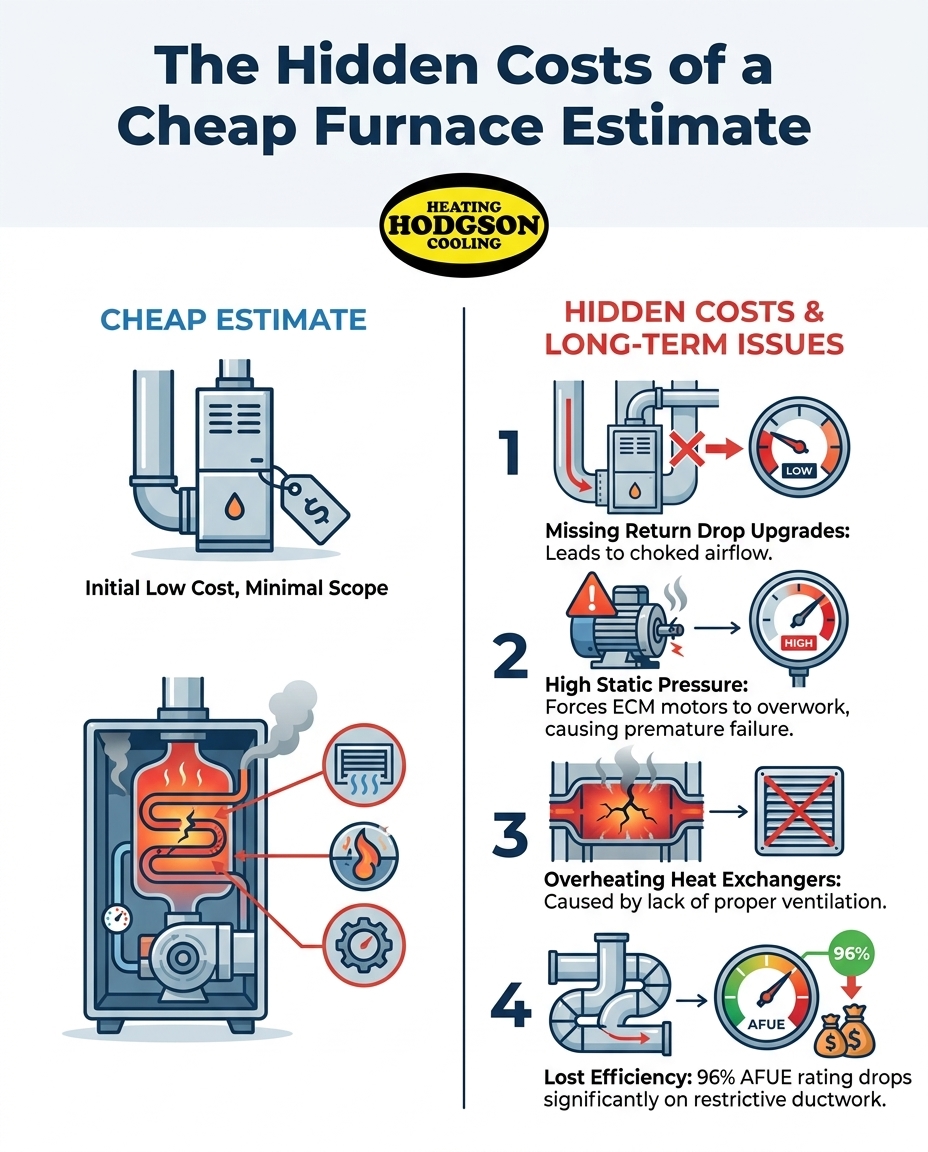
This brings us to static pressure. Static pressure is the resistance airflow faces as it moves through your ductwork. Think of it like blood pressure for your HVAC system. If the arteries (your ducts) are too narrow, the heart (your furnace) has to pump dangerously hard to circulate the air. Exceeding the static pressure limits on undersized return drops literally chokes your new system.
• Airflow starvation: The furnace cannot pull in enough cold air to cool its internal components.
• Increased friction: Air squeezing through tight spaces creates excessive noise and resistance.
• System suffocation: The blower motor strains against the vacuum created by the undersized duct.
Contractors who ignore the static pressure limits on undersized return drops are setting your system up for failure before they even turn it on for the first time.
How High Static Pressure Destroys Modern ECM Motors
The mechanical consequences of installing a high-efficiency unit on restrictive ductwork are severe, and they center entirely around your blower motor.
The Problem: Smart Motors on Dumb Ductwork
Older furnaces used simple, single-speed motors. If they encountered resistance, they just pushed a little less air. Modern furnaces, however, use ECM (Electronically Commutated Motor) technology. An ECM is a "smart" motor designed to adjust its speed automatically based on your home's airflow needs. It is programmed to deliver a specific volume of air, no matter what.
The Cause: Fighting the Restriction
When you attach an ECM motor to an undersized return drop, the motor senses the restriction. Because it is programmed to deliver a set amount of air, its internal computer tells it to ramp up its speed to overcome the blockage. The motor spins faster and faster, fighting against the high static pressure just to pull air through the narrow duct.
The Solution: Proper Sizing Prevents Catastrophe
This constant, maximum-capacity straining has disastrous long-term consequences. The motor consumes massive amounts of electricity, entirely erasing any energy savings you hoped to gain from your new high-efficiency furnace. More importantly, the motor eventually burns itself out from the extreme workload. Simultaneously, because the system still isn't getting enough air, the heat exchanger overheats, triggering safety shutoffs and potentially cracking the metal.
Replacing a burnt-out ECM motor is a massive, unexpected expense. The cost of replacing an ECM motor quickly eclipses whatever initial savings you gained from choosing the cheap "box swap" quote. Addressing the static pressure limits on undersized return drops upfront is the only way to protect this expensive component.
Evaluating AFUE Ratings and True System Efficiency
When homeowners compare estimates, they usually look straight at the AFUE rating. AFUE stands for Annual Fuel Utilization Efficiency. It measures how effectively a furnace converts gas into usable heat. A 96% AFUE furnace turns 96% of its fuel into heat for your home, while only 4% escapes up the exhaust pipe.
The Difference Between Lab Tests and Real-World Homes
Homeowners naturally want the highest rating possible to lower their utility bills. However, a 96% AFUE furnace cannot achieve 96% efficiency if it is starved for air. Those efficiency ratings are calculated in perfect laboratory conditions with zero airflow restrictions. If you install that premium furnace on a restrictive, undersized duct system, it has to burn more gas and use more electricity just to force the air through the house. Your "high-efficiency" system suddenly operates with terrible efficiency.
Why Industry Standards Matter
Professional HVAC sizing is governed by strict industry guidelines. The Air Conditioning Contractors of America (ACCA) publishes Manual D, the national standard for residential duct design. Both ACCA and the Department of Energy (DOE) clearly state that proper ductwork sizing is mandatory for modern furnaces to achieve their advertised efficiency ratings.
Comprehensive estimates prioritize true operational efficiency over just selling you a box with a fancy sticker. They include the necessary sheet metal transitions, duct expansions, and return drop replacements required to meet those ACCA guidelines. If a quote does not mention evaluating your ductwork or addressing the static pressure limits on undersized return drops, that contractor cannot guarantee the system will actually perform at its advertised efficiency.
Securing Reliable Heat Before the Freezing Weather Hits
The risks of a botched installation go far beyond energy bills and motor replacements. In our region, reliable heating is a matter of safety, not just comfort. Finalizing a proper, fully scoped installation during your October pre-winter heating startup window is critical before the severe weather arrives.
Battle Creek, MI historical winter climate data shows prolonged periods of freezing temperatures, heavy lake-effect snow, and biting winds that can push wind chills well below zero. During these deep freezes, your furnace runs nearly nonstop to protect your home and your family. If you accepted a cheap bid in the fall that left your new furnace suffocating on undersized ductwork, those prolonged sub-freezing weeks are exactly when the overworked ECM motor will finally fail.
A systemic breakdown in the dead of winter is an absolute emergency. Pipes can freeze, and homes become uninhabitable very quickly. The cost of emergency, after-hours repairs in January instantly erases any perceived savings from a cheap fall installation.
This is why working with a contractor who scopes the job correctly the first time is essential. Hodgson Heating & Cooling provides transparent, comprehensive estimates that account for necessary systemic upgrades upfront. By measuring your airflow, sizing your return drops correctly, and testing the static pressure, we ensure long-term reliability without hidden surprise costs later. You get the peace of mind knowing your system is built to handle the harshest Michigan winters without breaking a sweat.
Frequently Asked Questions About Furnace Estimates
Why is there such a big difference in HVAC quotes?
Differences usually stem from the scope of work, not just the equipment brand. While one contractor might just be quoting the price to swap the physical unit, another is quoting the cost to upgrade your ductwork, replace the return drop, and test the static pressure. Lower quotes almost always exclude these necessary modifications, leaving you with hidden installation flaws that cause major mechanical problems down the road.
What should be included in a furnace estimate?
A comprehensive estimate must include equipment specifications, labor, warranty details, and necessary airflow adjustments. It should clearly outline any sheet metal work needed to modify the existing ductwork so it meets the static pressure requirements of the new unit. If an estimate lacks details about duct transitions or return drop sizing, it is likely an incomplete quote that will lead to performance issues.
Is it worth paying more for a better HVAC system?
Investing in a properly scoped installation prevents premature mechanical failure and high energy bills. The total cost of ownership is often lower when the system is installed correctly the first time. Paying a little more upfront for proper duct modifications and airflow balancing saves you from replacing expensive ECM motors or cracked heat exchangers just a few years into the system's lifespan.
How do I compare HVAC quotes effectively?
Look beyond the bottom line and compare the specific line items and scope of work. Check if the cheaper bids are skipping crucial steps like replacing the return air drop or performing a static pressure test. Ask each contractor directly how they plan to address airflow and static pressure limits on undersized return drops with the new system to see who actually understands the technical requirements of your home.
Can a new furnace be installed on old ductwork?
Yes, but only if the old ductwork is evaluated and modified to handle the airflow demands of the new furnace. Installing a modern high-efficiency unit on restrictive old ductwork without modifications leads to overheating, poor air circulation, and immediate motor failure. A professional will always measure the existing ductwork and recommend necessary expansions before connecting a new unit.
Make an Informed Decision for Your Home's Heating Future
Choosing the right contractor to replace your heating system requires looking past the final price tag. The cheapest estimate often leads to the highest long-term costs due to systemic failures, overworked motors, and destroyed heat exchangers. A furnace is only as good as the ductwork it breathes through.
As you navigate your October pre-winter heating startup, remember to prioritize proper airflow requirements over a simple, cheap box swap. Protect your home by seeking out transparent, detailed quotes that clearly outline how the contractor will handle your return drops, static pressure, and overall system efficiency. Do not let a low initial bid trick you into a decade of expensive repairs. Contact our team today to schedule an expert evaluation and receive a comprehensive estimate you can trust.


