

The Hidden Cost of Placing Your Thermostat Near Drafty Entryways
Why Your Furnace Struggles During the First Cold Snap
Your furnace is running nonstop, but the house still feels chilly—a frustrating scenario that often reveals the hidden cost of placing your thermostat near drafty entryways. You turn on the heat for the first time in October, expecting cozy warmth to fill your living room. Instead, you hear the system roaring to life, shutting down a few minutes later, and then firing right back up. While the hallway might feel like a sauna, your bedrooms remain uncomfortably cold. This uneven heating is a classic problem that our team at Hodgson Heating & Cooling sees catching many homeowners off guard during the mid-fall heating-startup.
When faced with a furnace that seems to be working overtime without actually warming the house, it is completely natural to assume the worst. Most homeowners immediately suspect that their older heating system is failing, dying, or simply undersized for the property. The thought of replacing an entire HVAC system is stressful. However, before you start researching new furnaces, it is vital to look at the small device controlling the entire operation: your thermostat.
The Misdiagnosis of a Failing Heating System
A heating system is only as smart as the instructions it receives. If your thermostat is mounted on a wall directly across from a drafty front door, it is receiving terrible information. The furnace itself might be in perfect mechanical condition, fully capable of heating your entire home. The real culprit is the placement of the sensor. The thermostat is reacting to a constant stream of cold air from the entryway, forcing the furnace to work relentlessly to warm up a space that refuses to hold heat.
Understanding this dynamic is the first step in solving the problem. Professional diagnosis is the key to identifying these placement issues before you spend money replacing expensive equipment that is actually functioning exactly as it was commanded to. A poorly placed thermostat will make a brand-new furnace perform just as badly as an old one.
How Drafty Entryways Create Deceptive Micro-Climates
To understand why a drafty door causes such widespread heating problems, we have to look at how a thermostat actually works. Your thermostat does not measure the average temperature of your entire house. It does not know that your upstairs bedroom is freezing or that your living room is perfectly comfortable. It only measures the ambient air in its immediate vicinity—usually within a radius of just a few feet.
When cold air seeps through the weatherstripping of an entryway, it creates a localized cold zone. With freezing winter winds in Michigan rapidly dropping the temperature near exterior doors, this effect is drastically amplified. The air pooling around the front door can easily be five to ten degrees colder than the air in the center of your home. If your thermostat is sitting right in the middle of that cold zone, it creates a deceptive micro-climate.
The Illusion of a Freezing House
This specific micro-climate tricks the HVAC system into thinking the entire house is freezing. The sensor registers the cold draft and sends an urgent signal to the furnace to start producing heat. Because the thermostat is the only source of truth for your heating system, the furnace blindly follows the command, pumping hot air into every room of the house.
What happens next is a cycle of extreme temperature imbalances:
• Entryway/Hallway — Actual Temperature: 62°F (due to draft) — Thermostat Reading: 62°F — System Response: Calls for continuous heat
• Living Room — Actual Temperature: 72°F (comfortable) — Thermostat Reading: Unknown to system — System Response: Receives unnecessary heat
• Upstairs Bedroom — Actual Temperature: 75°F (overheating) — Thermostat Reading: Unknown to system — System Response: Becomes uncomfortably hot
This localized draft results in false low temperature readings near the entryway. The system keeps running to satisfy the thermostat, baking the rest of the house while the hallway remains stubbornly cold. This drastically uneven heating is a direct result of the system trying to fix a micro-climate that cannot be fixed with forced air alone.
The Mechanical Chain Reaction: Furnace Short-Cycling
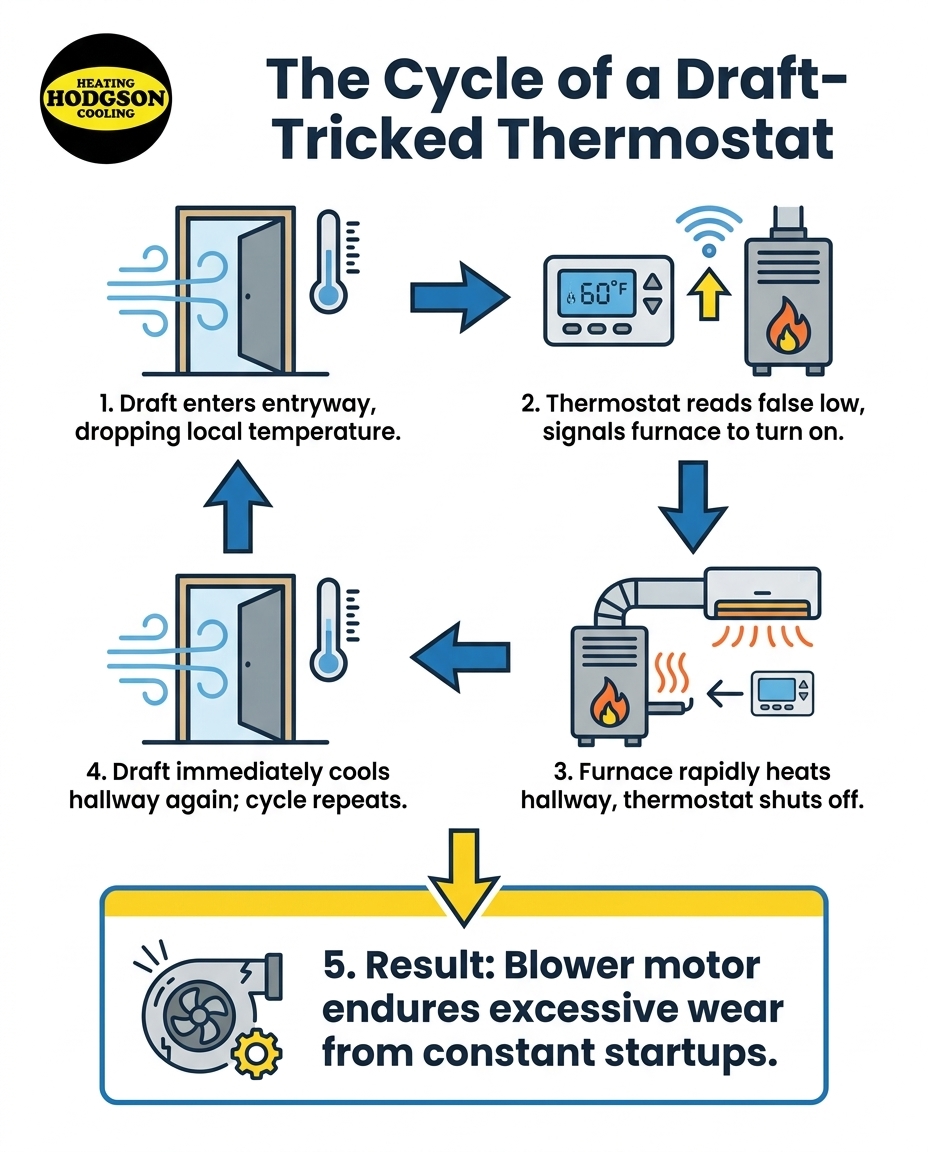
The problems caused by a poorly placed thermostat go far beyond just feeling a little too warm in the living room. The most destructive consequence is a mechanical chain reaction known as short-cycling. Short-cycling occurs when your furnace turns on and off far more frequently than it was designed to. Instead of running for a steady, efficient fifteen minutes to warm the house, the system fires up, runs for three minutes, shuts down, and immediately starts again.
The Problem: When a thermostat is located near a drafty door, it detects the cold air and turns the furnace on. The heating vents in the hallway quickly blast hot air into that small, confined space.
The Cause: Because hallways are typically narrow, the ambient air temperature around the thermostat rises very rapidly. The thermostat thinks the job is done and shuts the furnace off. However, the moment the hot air stops blowing, the continuous draft from the front door immediately cools the hallway down again. Within minutes, the thermostat detects the cold draft and commands the furnace to turn back on.
The Toll on Your Heating Equipment
This rapid-fire cycle is incredibly hard on your heating equipment. A healthy heating cycle is long and steady. It allows the heat exchanger to warm up properly and distributes air evenly throughout the ductwork. In contrast, short-cycling prevents the system from ever reaching its peak operating efficiency.
In our years of serving the community, the technicians at Hodgson Heating & Cooling see this specific chain reaction frequently in older Battle Creek homes, where original floor plans often placed thermostats right by the front door for convenience. This constant stopping and starting requires significantly more energy than running steadily. It is the mechanical equivalent of driving a car in stop-and-go traffic versus cruising on the highway—your gas mileage plummets, and the wear on the vehicle increases dramatically.
The Real Victim: Premature Blower Motor Wear
While short-cycling wastes energy and drives up utility bills, the hidden cost lies deep inside the furnace cabinet. The real victim of a draft-tricked thermostat is the blower motor. The blower motor is one of the hardest-working and most critical components of your entire HVAC system. Its job is to push the heavy, conditioned air through the ductwork and out of the vents into every room of your house.
To understand why short-cycling is so damaging, you have to understand how electric motors operate. The most intense wear and tear on any heavy-duty motor occurs during the startup phase, not while it is running smoothly. When a blower motor first kicks on, it requires a massive surge of electrical torque to overcome the resting inertia of the fan blades. This initial jolt generates a significant amount of heat within the motor windings and places physical stress on the bearings.
The Hidden Cost of Constant Startups
Under normal conditions, a blower motor might start up three to four times an hour. The motor has plenty of time to cool down between cycles. But when draft-induced short-cycling takes over, that same motor might be forced to endure ten, fifteen, or even twenty unnecessary startups in a single hour.
This relentless demand accelerates mechanical degradation. The motor never gets a chance to cool down, causing the electrical insulation inside the windings to bake and degrade. The bearings dry out faster, and the run capacitor—the component that helps deliver that initial electrical jolt—burns out prematurely. What starts as a simple draft during the mid-fall heating-startup eventually leads to early failure of the motor, resulting in a sudden and total loss of heat when you need it most.
Historic Architecture vs. Modern Heating Demands
The charm of historic architecture is a major draw for homeowners. Original wood entryways, expansive single-pane transom windows, and grand foyers give classic homes a character that modern builds simply cannot replicate. However, these beautiful older designs were not built with modern HVAC airtightness in mind. A hundred years ago, homes were designed to breathe, meaning they are naturally drafty by today's standards.
In our experience at Hodgson Heating & Cooling diagnosing heating inefficiencies in older Battle Creek homes, we frequently see how these architectural quirks clash with modern heating demands. When central heating became common in the mid-20th century, installers typically placed thermostats in central hallways. At the time, it seemed like the most logical, accessible place. Today, however, those grand central hallways are often the draftiest locations in the entire house.
Adapting Classic Layouts for Efficiency
You cannot easily change the architectural layout of a historic home without destroying its character, but you absolutely must adapt modern heating controls to work effectively within these classic layouts. A high-efficiency furnace paired with a smart thermostat is a powerful combination, but if that smart thermostat is mounted next to an original 1920s oak front door, it will perform poorly.
Modern HVAC systems require accurate, stable temperature readings to modulate their heating output correctly. Overcoming the challenges of historic architecture means acknowledging that the center of the home is no longer the best place for a temperature sensor if that center is exposed to exterior drafts.
Signs Your Thermostat Needs Professional Relocation
If you suspect your heating system is struggling due to poor placement, there are several clear indicators to look for. Identifying these symptoms early can save your blower motor from irreversible damage. However, recognizing the problem is only the first step; fixing it requires professional intervention.
Look for these common signs of poor thermostat placement:
• The furnace is running constantly: You hear the system cycling on and off in rapid bursts, rarely running for more than a few minutes at a time.
• Severe cold spots: Your living areas and bedrooms remain uncomfortably chilly while the hallway where the thermostat is located feels overly warm.
• Proximity to exterior doors: The thermostat is mounted within a few feet of a front or back door, especially one with noticeable drafts.
• False readings: You notice false low temperature readings near the entryway that do not match how the rest of the house feels.
Why Relocation is Not a DIY Project
Moving a thermostat might seem as simple as hanging a picture frame, but it is actually a complex electrical task. Relocating the unit involves rerouting low-voltage wiring through wall cavities, navigating around studs and fire blocks, and properly patching drywall.
As licensed HVAC professionals, our team at Hodgson Heating & Cooling strictly warns against DIY relocation attempts. The wires connected to your thermostat communicate directly with the main control board inside your furnace. Crossing the wrong wires, pinching a line behind the drywall, or causing a short circuit can instantly fry the furnace control board, turning a simple relocation into a major repair.
Furthermore, a professional technician knows exactly how to find the optimal interior wall. They will identify a location that is shielded from direct sunlight, away from heat-generating appliances, and isolated from exterior drafts to ensure accurate, whole-home temperature readings. If you are looking to optimize your system further, implementing energy saving thermostat tips works best only after the unit is installed in the correct location.
Frequently Asked Questions About Thermostat Placement
Why is my furnace running constantly but the house is cold?
If your furnace is running constantly but your house remains cold, your thermostat is likely reading a localized cold spot rather than the actual room temperature. When a thermostat is mounted near a drafty door or a poorly insulated window, it registers that specific cold air and commands the furnace to run. The furnace heats the house, but because the cold draft never stops, the thermostat never senses the warmth, causing the system to overwork while the rest of your home remains uncomfortable.
Can a draft affect a thermostat?
Yes, a draft has a massive impact on a thermostat's performance. Thermostats do not measure the average temperature of your entire home; they only measure the air immediately surrounding their internal sensor. A persistent cold draft will cause the thermostat to register a false low temperature, tricking your HVAC system into thinking the whole house is freezing and triggering unnecessary heating cycles.
Where is the worst place to put a thermostat?
The worst places to install a thermostat are areas subject to extreme temperature fluctuations that do not represent the rest of the home. This includes walls right next to exterior doors, directly above or below air vents, in hallways that receive direct sunlight, or near heat-generating appliances like ovens and lamps. Placing a thermostat in any of these locations will guarantee uneven heating and cooling.
Does a short-cycling furnace use more energy?
Yes, a short-cycling furnace uses significantly more energy than a system running in normal, sustained cycles. The constant stopping and starting draws a heavy surge of electrical power each time the blower motor kicks on. Additionally, the furnace never runs long enough to reach its peak operating efficiency, meaning you are paying for maximum energy consumption while receiving minimal heating comfort.
Can I move my thermostat myself?
It is highly recommended to hire a professional to move your thermostat. Relocating the device requires pulling new low-voltage wiring through your walls and ensuring the new location is structurally and thermally appropriate. Mishandling the wiring can easily short out the expensive control board inside your furnace, resulting in a system breakdown and a costly repair bill.
Protect Your Heating System with Strategic Placement
An overworking furnace is not always a sign of total system failure; sometimes, it might just be the victim of a drafty front door. When a thermostat is constantly bombarded by cold air, it forces your entire HVAC system into a destructive cycle of rapid starts and stops. This deceptive micro-climate tricks the system, wastes energy, and leaves your living spaces feeling uncomfortably chilly.
The most important takeaway is that a professional thermostat relocation can save your blower motor from premature failure. By moving the sensor to a neutral, interior wall, your furnace can finally read the true temperature of your home and run in smooth, efficient cycles. If you notice uneven heating or rapid cycling during the mid-fall heating-startup, do not wait for the motor to burn out. Have your system evaluated by a professional to ensure your thermostat is working for you, not against you.


