

The Danger of Wrapping Your AC Unit Too Tightly for Winter
Why Your October Fall Cleanup Dictates Next Spring's AC Health
Before the first heavy snow arrives, many homeowners beginning their October fall cleanup are completely unaware of the danger of wrapping your AC unit too tightly for winter. As you rake the last leaves and clear your gutters, a common debate arises in the backyard: how best to protect the outdoor condenser from incoming ice and freezing rain. Many well-meaning homeowners assume that hermetically sealing the equipment is the safest route to prepare for a harsh Michigan winter. While a heavy-duty plastic tarp might look like the ultimate shield against the elements, it actually creates a destructive micro-environment that can ruin your equipment long before spring arrives.
Understanding how modern air conditioning systems are engineered to handle weather is the key to avoiding costly mistakes. The outdoor condenser is not a delicate appliance; it is a rugged piece of machinery designed specifically to live outside year-round. When you disrupt its natural ability to breathe, you inadvertently introduce severe hidden threats—namely, trapped moisture and nesting pests. Our team at Hodgson Heating & Cooling has seen firsthand how making the right decision during your pre-winter yard work dictates whether your system will start up flawlessly on the first hot day of next year, or whether you will be facing an expensive, preventable breakdown.
The Myth of the Airtight Winter Tarp
A pervasive myth in home maintenance is that outdoor HVAC equipment needs to be entirely shielded from winter weather to survive. In reality, these systems are specifically manufactured to withstand extreme temperature fluctuations, torrential rain, and heavy snow loads. The internal components are housed in weather-resistant materials, featuring galvanized steel cabinets, baked-on powder-coat paint finishes, and aluminum fins that do not require an additional layer of plastic wrapping to stay safe.
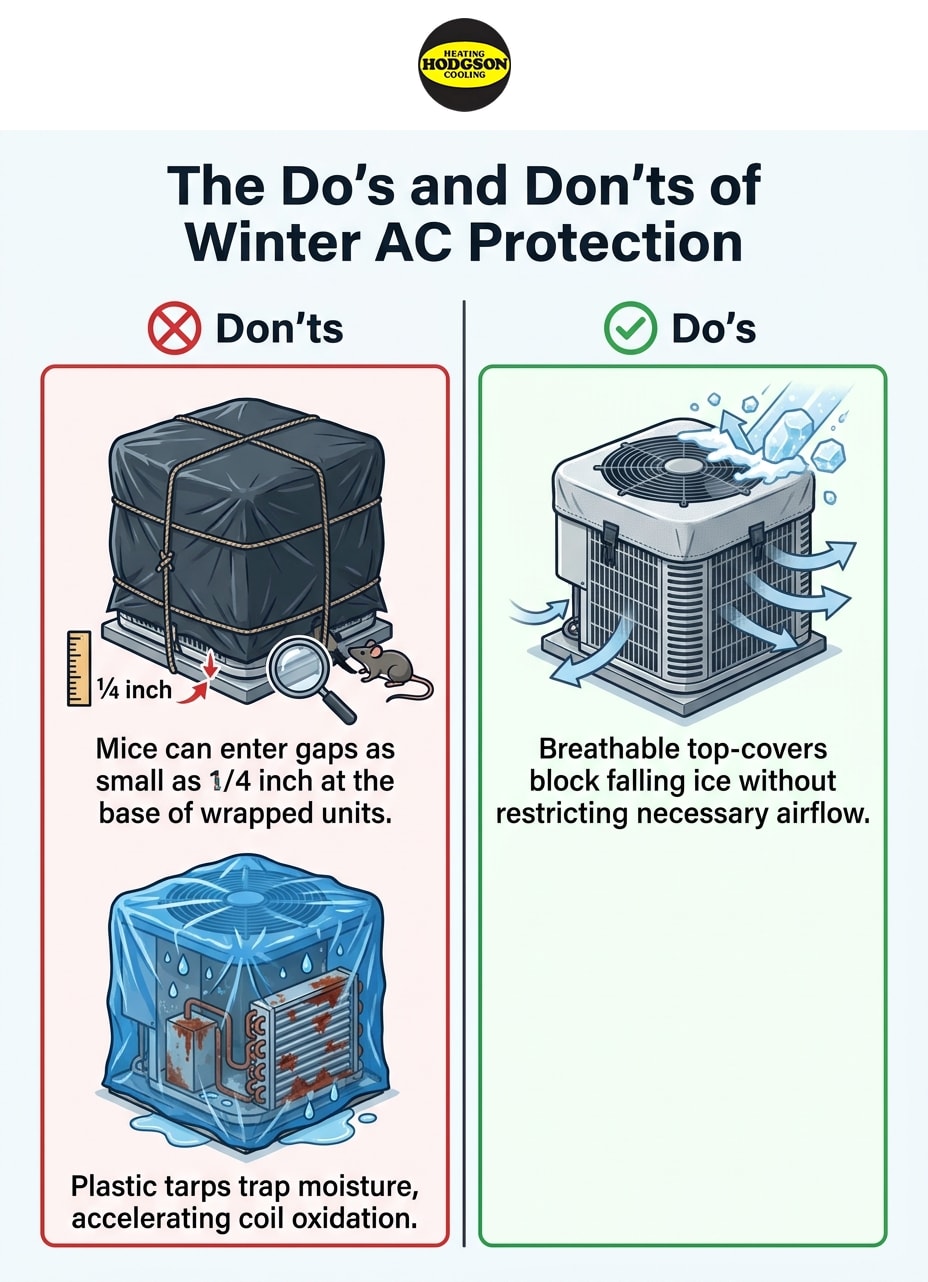
Applying a tight tarp creates an artificial, stifling environment that disrupts the unit's ability to naturally dry out after a rainstorm or snowmelt. Manufacturers generally advise strongly against full plastic wraps, as they cause significantly more harm than the winter weather itself. By sealing the unit, you block the natural airflow that keeps the internal components dry, leading directly to trapped condensation and rodent wiring damage when pests seek out that newly created shelter.
How Modern Condensers Handle the Cold
To understand why wrapping is unnecessary, it helps to look at the robust engineering of your outdoor unit. These systems are tested in extreme weather chambers before they ever reach the market.
• Heavy-duty exterior casing: The louvered side panels are designed to let wind pass through while deflecting large debris. The metal is treated to resist rust even when buried in snow.
• Weather-rated electronics: The fan motors, contactors, and capacitors are sealed inside protective compartments that keep out direct precipitation.
• Natural ventilation requirements: Even when the system is completely dormant during the winter months, it relies on ambient airflow to evaporate morning dew and ground moisture.
• Full Plastic Tarp — Assumed Benefit: Keeps all snow and water out of the unit. — Actual Reality: Traps ground moisture inside, accelerating severe rust and corrosion.
• No Cover At All — Assumed Benefit: Allows maximum airflow for drying. — Actual Reality: Leaves the fan blades vulnerable to damage from heavy falling icicles.
• Breathable Top-Cover — Assumed Benefit: Shields the top from ice while letting sides breathe. — Actual Reality: The manufacturer-approved method for balancing protection and airflow.
The Physics of Trapped Moisture and Coil Corrosion
The Problem: When you secure a tight plastic cover over your condenser, you are essentially building a miniature greenhouse in your backyard. Even in the dead of winter, the ground beneath the unit holds moisture. As the sun hits the dark plastic tarp, the temperature inside the cover rises slightly, causing that ground moisture to evaporate upward.
The Cause: Because the heavy plastic offers no ventilation, this evaporated moisture has nowhere to escape. It hits the cold underside of the tarp and condenses, dripping directly back onto the sensitive internal components. For homes in Battle Creek MI and surrounding areas, our frequent winter freeze-thaw cycles make this trapped condensation particularly destructive. The moisture repeatedly freezes into ice on the internal coils at night, then thaws back into water during the day.
The Solution: Constant exposure to this trapped, high-humidity environment accelerates oxidation on the sensitive copper and aluminum components. This accelerated rust eats away at the metal, degrading the system's efficiency and often leading to premature refrigerant leaks. The only way to stop this physics-driven corrosion is to remove the airtight barrier. Allowing the wind to circulate through the louvered sides of the condenser ensures that moisture naturally evaporates and blows away, keeping the internal coils dry and intact throughout the coldest months.
Unwanted Winter Guests: The Rodent Risk
Beyond the threat of rust, a tightly wrapped AC unit introduces a biological hazard to your HVAC system. As temperatures drop sharply in October, local rodent populations begin migrating away from open fields and into residential areas in search of warm, dry, and secure shelter. A fully wrapped AC unit provides the perfect real estate for a winter nest. The plastic blocks the harsh winter wind, traps any ambient heat radiating from the house, and creates an environment completely free from natural predators like owls and neighborhood cats.
Mice are incredibly resourceful and can squeeze through gaps as small as a quarter of an inch. Even if you think you have secured the tarp tightly with bungee cords, the corrugated base of the condenser provides easy access points. Once inside, they use the insulation, leaves, and debris to build extensive nests right against the compressor.
As a local company, our technicians at Hodgson Heating & Cooling see the costly results of these plastic-wrapped units every single spring. When our team performs pre-season start-ups, we frequently pull off winter covers only to discover massive rodent nests packed tightly into the electrical compartments. Taking the right preventative steps during your October fall cleanup and pre-winter yard work is the easiest way to avoid needing extensive professional AC service just to clear out pest debris and sanitize the equipment before it can be safely operated.
The Dangers of Chewed Wiring and Pest Damage
The presence of a nest is only the beginning of the problem. Rodents have continuously growing incisors, which means they naturally chew on materials to file their teeth down. The insulated, high-voltage wiring inside an AC unit is a prime target for this behavior. They will strip the insulation right off the wires that connect your compressor, fan motor, and capacitor, leaving bare copper exposed to the elements and to each other.
The cascading effects of chewed wiring include:
• Catastrophic electrical shorts: When bare wires touch the metal casing or cross paths, they create immediate electrical shorts that can destroy the control board.
• Blown fuses and tripped breakers: A compromised circuit will continuously trip your electrical panel, completely disabling the cooling system.
• Permanent compressor damage: If the compressor receives erratic voltage due to damaged wiring, the motor can burn out entirely, often requiring a full system replacement.
It is critical to understand that repairing compromised high-voltage wiring is extremely dangerous. The capacitors inside your condenser hold a lethal electrical charge even when the power to the house is turned off. Never attempt DIY electrical repairs if you open your unit in the spring and discover chewed wires. If you see signs of trapped condensation and rodent wiring damage, secure the unit, leave the disconnect switch in the "off" position, and call for AC repair in Marshall or your immediate local area. A licensed professional must test the circuits, safely discharge the capacitors, and splice or replace the damaged harnesses according to electrical codes.
The Right Way to Protect Your Condenser from Snow and Ice
If full plastic tarps are dangerous, how should you protect your equipment? The answer lies in targeted, breathable protection. Instead of a full wrap, the industry best practice is to use a breathable top-cover designed specifically for HVAC units. This approach shields the most vulnerable part of the system—the large fan opening at the top—without suffocating the internal components.
For homeowners in Battle Creek MI and surrounding areas, where we average over 50 inches of annual snowfall, top-protection is highly recommended. Heavy icicles falling from the roof, dense snow loads, and snapping tree branches can easily bend the aluminum fan blades or dent the top grille. A sturdy top-cover absorbs these impacts and keeps heavy debris out of the fan motor housing.
Crucially, leaving the sides open allows for proper cross-breeze airflow. The wind can pass through the unit, ensuring that any moisture naturally evaporates away from the coils. Combining this specific outdoor strategy with general winter preparation tips for efficient heating systems ensures your entire home infrastructure is fully ready for the cold weather.
Key Features of a Safe AC Cover
When shopping for winter protection during your fall hardware store run, look for these specific design elements to ensure you aren't accidentally buying a moisture trap:
1. Breathable materials: The cover should be made of durable canvas, heavy-duty woven mesh, or a specialized breathable synthetic fabric—never solid polyethylene plastic.
2. Short side overhangs: A safe cover only extends a few inches down the sides of the unit, just enough to secure it in place, leaving the vast majority of the louvered side panels completely exposed to the air.
3. Secure fastening systems: It must secure tightly at the top using strong straps or specialized hooks to withstand intense winter winds without blowing away or shifting off-center.
Frequently Asked Questions About AC Winterization
Should I cover my AC unit in the winter?
You should only cover the top of the unit, never the sides. Using a breathable top-cover protects the fan blades and internal motor from falling icicles, heavy snow loads, and winter debris. However, wrapping the entire unit in plastic is highly discouraged by manufacturers because it traps moisture and invites pests.
Why shouldn't you wrap your AC unit in plastic?
Wrapping your AC unit in plastic creates an airtight seal that prevents ground moisture from evaporating. This trapped humidity repeatedly freezes and thaws on the internal components, causing accelerated rust and corrosion on the sensitive copper coils. Additionally, a fully wrapped unit creates a warm, wind-blocking shelter that attracts mice and other rodents.
How do you protect an AC unit from snow and ice?
The safest way to protect your AC unit from snow and ice is to install a heavy-duty, breathable top-cover that only covers the upper grille. Alternatively, some homeowners place a piece of plywood cut to size over the top, weighed down with a brick, to deflect falling ice while leaving the sides completely open for maximum airflow.
Do mice chew AC wires in winter?
Yes, mice frequently chew AC wires during the winter if they nest inside the unit. Rodents need to constantly gnaw on materials to file down their growing teeth, and the insulated electrical wiring inside an AC condenser is a common target. This leads to severe electrical shorts and the need for professional repairs in the spring.
What happens if you cover your AC unit completely?
If you cover your AC unit completely, you block the natural ventilation it needs to stay dry. The resulting greenhouse effect traps condensation, leading to rust, mold growth, and degraded electrical components. It also transforms the condenser into a safe, predator-free nesting ground for local wildlife.
Can a breathable AC cover prevent rust?
A breathable AC cover helps prevent rust by allowing wind to circulate through the unit, which naturally evaporates standing water and condensation. Unlike a solid plastic tarp that locks moisture inside, a breathable cover shields the unit from direct precipitation while ensuring the internal environment remains dry enough to prevent rapid oxidation.
Ensure Your System is Ready for Winter
Protecting your outdoor equipment correctly during your fall cleanup prevents massive headaches and unexpected bills next spring. By skipping the airtight plastic wrap and opting for breathable top protection, you easily avoid the traps of condensation and rodents. Ensure your entire HVAC system is prepared for the dropping temperatures by scheduling an AC tune-up in Battle Creek before the heavy snow arrives, giving you peace of mind all winter long.


