

Navigating the September Thermostat Tug-of-War in Michigan
The Dilemma of Michigan's Extreme Daily Temperature Swings
Your house is freezing when you wake up, but by 3 p.m., the living room feels like a sauna. Navigating the September Thermostat Tug-of-War in Michigan is a frustrating reality for many homeowners who just want to stay comfortable. You bump the heat up in the morning just to take the chill off, then manually flip the system over to cooling a few hours later when the afternoon sun hits the windows. It feels like a logical way to manage the shifting weather, but this constant back-and-forth places severe, hidden mechanical stress on your HVAC system.
During the September early fall transition, our team at Hodgson Heating & Cooling sees firsthand how Battle Creek experiences specific diurnal temperature variations that can be incredibly demanding on a home's climate control. It is not uncommon for morning lows to sit near freezing, only for afternoon highs to swing 20 to 30 degrees warmer within a matter of hours. This rapid shift creates a volatile indoor environment, tempting you to constantly adjust the thermostat.
Here is the thing: your heating and cooling equipment was designed for long, steady cycles, not rapid-fire toggling. When you constantly switch between "Heat" and "Cool" multiple times a day, you force the system to rapidly halt one complex mechanical process and immediately initiate another. This habit causes significant wear and tear on electrical components, leading to premature equipment failure rather than just higher energy bills. Understanding the mechanical reality of what happens inside your system is the first step to staying comfortable without risking an unexpected breakdown.
What Happens Inside Your HVAC System During Rapid Mode Switching
To understand why the thermostat tug-of-war is so damaging, we need to look at the physical and mechanical reality of switching an HVAC system from cooling to heating without adequate resting time. Your air conditioner and your furnace (or heat pump) operate using entirely different mechanical processes, and forcing them to tag-team your indoor climate requires careful orchestration.
When your air conditioner is running, the compressor is heavily pressurized, pumping chemical refrigerant through the lines to absorb and remove heat from your home. If you abruptly shut the cooling cycle off and immediately demand heat, that highly pressurized refrigerant has not had time to settle. This lack of refrigerant pressure equalization means the system is caught off guard, trying to start a new cycle while fighting against the intense pressure of the previous one.
Here is exactly what happens mechanically during rapid mode switching:
1. The Abrupt Stop: The thermostat sends a signal to immediately cut power to the cooling cycle, leaving refrigerant pressures highly unbalanced between the indoor and outdoor coils.
2. Thermostat Confusion: Older thermostats process rapid changes poorly, often leading to delayed signal processing or sending mixed electrical signals to the control board.
3. The Strained Restart: When the heat is immediately engaged, the blower motor and internal components are forced to reverse their operational logic instantly, drawing massive amounts of electrical current to overcome the unbalanced pressure.
4. User-Induced Short-Cycling: The system rapidly turns on and off in short bursts, a phenomenon known as short-cycling, which is caused by user interference rather than an actual equipment malfunction.
Our technicians frequently trace early fall system lockouts right back to this specific rapid-switching behavior. When a system in Battle Creek shuts down unexpectedly in late September, it is very often because the internal safeties tripped after being forced to switch modes too quickly.
The Hidden Victim: Why Capacitors Fail During the Fall Transition
If there is one component that suffers the most during the September early fall transition, it is the capacitor. This small, cylindrical electrical part is the hidden victim of the thermostat tug-of-war, and its failure is one of the most common reasons homeowners lose climate control right when they need it most.
The Problem: Your HVAC system requires a massive jolt of electricity to start the compressor and fan motors—far more power than your home's standard electrical wiring can provide at once. The capacitor acts like a powerful, short-term battery, storing electricity and delivering that crucial initial jolt to get the heavy motors spinning.
The Cause: When you engage in rapid short-cycling and constant mode switching, you force the capacitor to endure significantly higher stress loads. Instead of discharging once and letting the system run for an hour, the capacitor is forced into frequent, unnatural discharge cycles. It has to deliver that massive jolt over and over again in a short period. This rapid charging and discharging generates excessive heat within the component, eventually causing its internal fluids to expand, bulge, and fail completely.
The Solution: Patience is your best defense against capacitor failure. At Hodgson Heating & Cooling, our technicians see a predictable spike in blown capacitors during these specific transition weeks, almost entirely driven by rapid thermostat adjustments. If your system is struggling to turn on, or if you hear a loud humming noise coming from the outdoor unit without the fan spinning, you likely have a strained or blown capacitor.
Because a blown capacitor completely halts both heating and cooling capabilities, it is a frustrating breakdown to deal with. Replacing a capacitor involves handling high-voltage stored electricity, meaning it must be tested and replaced by a licensed professional to ensure safety and proper system calibration.
Compressor Lockouts: When Your System Protects Itself
Sometimes, when you flip the switch from AC to heat, the system simply refuses to turn on. You might assume the entire unit has broken down, but in our experience, your HVAC system is actually protecting itself from the thermostat tug-of-war. This self-preservation mode is known as a compressor lockout.
According to ASHRAE guidelines regarding compressor safety, modern HVAC equipment is designed with internal sensors that monitor refrigerant pressure and electrical draw. Because pressure equalization is an absolute necessity for safe operation, these sensors will intentionally break the electrical circuit if they detect that the system is being forced to restart under unsafe pressure conditions.
A compressor lockout is essentially the system raising a red flag to prevent the compressor motor from burning out. The compressor is the heart of your cooling system and one of the most expensive components to replace. If it tries to start against the immense back-pressure of unequalized refrigerant, the motor can overheat, seize up, and suffer permanent mechanical failure.
When a lockout occurs, the system will typically force a mandatory resting period. This lockout usually lasts anywhere from five to fifteen minutes, depending on the make and model of your equipment. During this time, the system will ignore all commands from the thermostat. Attempting to force the system back on by rapidly flipping the breaker or mashing the thermostat buttons will only prolong the lockout and can cause permanent damage to the control board.
It is important to clarify the difference between a temporary lockout and a true mechanical failure requiring professional repair in Battle Creek:
• System Response — Temporary Compressor Lockout: Completely unresponsive to thermostat changes for 5-15 minutes. — True Mechanical Failure: Unresponsive for hours, or repeatedly trips the circuit breaker.
• Noises — Temporary Compressor Lockout: Silence. The system is intentionally cutting power to protect itself. — True Mechanical Failure: Loud buzzing, grinding, or clicking noises from the outdoor unit.
• Resolution — Temporary Compressor Lockout: System resumes normal operation automatically after pressures equalize. — True Mechanical Failure: Requires a licensed technician to diagnose and replace failed parts.
Safe Temperature Management Strategies for Volatile Weather
You do not have to suffer through freezing mornings and boiling afternoons just to protect your HVAC system. There are safe, highly effective alternatives to constant thermostat toggling that allow you to maintain comfort during the September early fall transition without damaging your equipment.
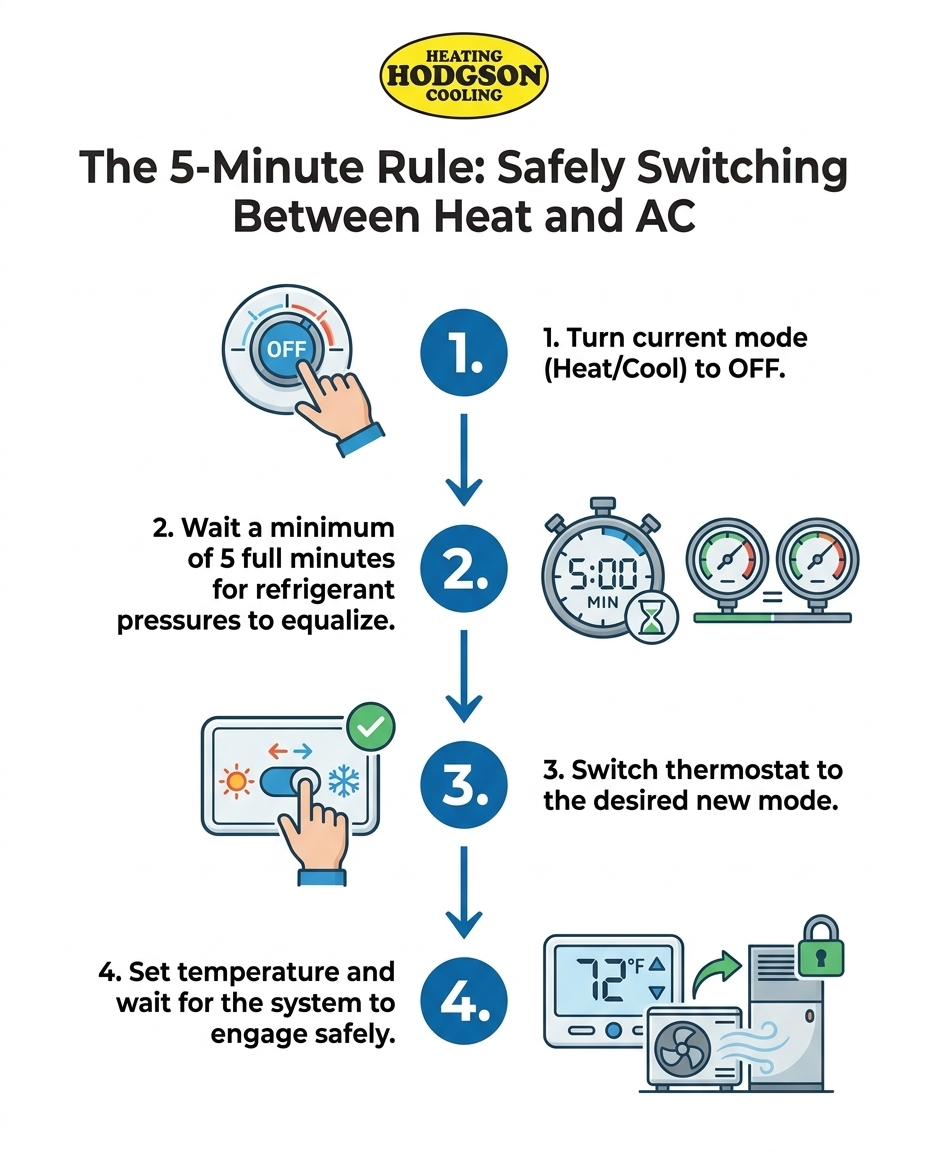
The most important habit we recommend you adopt is the 5-Minute Rule. If you absolutely must switch your system from cooling to heating (or vice versa), always turn the system to the "Off" position first. Wait a minimum of five full minutes before engaging the new mode. This crucial window allows the highly pressurized refrigerant to settle and equalize, ensuring that the compressor can start safely without fighting against extreme back-pressure.
Beyond the 5-Minute Rule, consider these strategic management techniques for volatile weather:
• Utilize ceiling fans strategically: Ceiling fans are excellent at bridging the comfort gap during the middle of the day. Running a fan counterclockwise creates a wind-chill effect that makes the room feel cooler without needing to engage the air conditioner.
• Practice active window management: When the afternoon sun warms up the house, open your windows to flush out the stale morning chill and capture the natural breeze. This passive cooling technique is often enough to keep the house comfortable until the sun goes down.
• Address uneven temperatures: If one room is boiling while another is freezing, it might be an airflow issue rather than a weather issue. Learning more about managing AC temperature inconsistencies can help you balance your home's climate without constantly adjusting the main thermostat.
Optimizing Your Programmable Thermostat for Fall
If you have a programmable or smart thermostat, you can automate your comfort safely by setting a wider temperature deadband. The deadband is the mandatory gap between your heating setpoint and your cooling setpoint.
During the fall, set your thermostat to "Auto" mode, but widen the deadband to at least 5 or 6 degrees (for example, set the heat to kick on at 66 degrees and the AC to kick on at 74 degrees). This wide gap ensures that the system is not constantly fighting itself. Department of Energy setback guidelines are particularly useful during these transition months, as allowing your home's temperature to drift slightly naturally saves energy and prevents the rapid short-cycling that destroys capacitors.
Preparing Your Equipment for the True Heating Season
While daily temperature management is critical during the early fall, it is equally important to transition your focus toward long-term seasonal readiness. The components that get stressed during the volatile September weeks—especially capacitors and contactors—rarely fail completely while the weather is mild. Instead, they limp along, quietly degrading, until they fail completely when the first true winter freeze hits Battle Creek.
A proactive pre-season inspection is the best way to catch these strained components early. During a fall tune-up, our technicians will test the electrical draws on your motors and measure the microfarad output of your capacitor. If the capacitor was weakened by the thermostat tug-of-war, we can identify the drop in performance and address it before the component bursts and leaves you without heat on a freezing night.
Routine check-ups also restore the efficiency that was lost during the heavy summer cooling season. Dust and debris on the blower motor, dirty flame sensors, and clogged air filters all force the system to work harder than necessary.
We recently helped a local customer who reached out during a past winter season seeking general HVAC service and heating and cooling efficiency tips. Our technician provided prompt and efficient service, taking the time to explain everything and offering practical tips for efficient operation. Getting that kind of thorough explanation and preventative care from our team before the snow flies ensures your units are kept in tip-top shape year after year, and it is far less stressful than dealing with an emergency mid-winter breakdown.
Frequently Asked Questions About Early Fall HVAC Settings
Is it bad to switch from AC to heat in the same day?
It is not inherently bad to switch modes in the same day, provided you do it safely. The danger lies in rapid switching without giving the system time to rest. If you follow the 5-minute rule and allow refrigerant pressures to equalize, your system can safely transition from cooling to heating to accommodate volatile early fall weather.
How long should I wait before switching from AC to heat?
We highly recommend waiting a minimum of five full minutes after turning off the AC before turning on the heat. This mandatory resting period allows the highly pressurized chemical refrigerant to settle. Failing to wait can cause the system to trigger a compressor lockout to protect the motor from burning out.
What should my thermostat be set at in the early fall?
During the early fall transition, it is best to set a wide temperature deadband on your thermostat. Setting your heat to activate around 66 degrees and your cooling to activate at 74 degrees provides a comfortable buffer. This prevents the system from constantly toggling back and forth as the sun moves across your house.
Why does my AC compressor lock out when I switch modes?
Your compressor locks out as a built-in safety mechanism to prevent catastrophic motor failure. When you switch modes too quickly, the system detects unsafe, unequalized refrigerant pressure. The control board intentionally breaks the circuit, forcing a 5 to 15-minute resting period so the system does not destroy itself trying to start against that extreme pressure.
What are the signs that my HVAC capacitor is failing?
A failing capacitor often produces a loud humming or buzzing noise from the outdoor unit, while the fan blades remain completely still. You may also notice the system struggling to turn on, short-cycling rapidly, or failing to produce cold air. Because the capacitor stores high-voltage electricity, these symptoms indicate that you need a professional to safely test and replace the component.
Protect Your System During the Seasonal Shift
Navigating the unpredictable weather in Battle Creek requires a bit of strategy, but patience with your thermostat ultimately saves money on premature mechanical failures. By understanding the strain that rapid mode switching places on your equipment, you can avoid blown capacitors and frustrating system lockouts.
As the weather continues to cool down, take the time to ensure your system is fully prepared for the heavy lifting ahead. Catching a weakened electrical component now is always better than waking up to a freezing house in January. Schedule your seasonal maintenance before the harsh winter weather arrives, and reach out to our team at Hodgson Heating & Cooling to give your system the thorough check-up it needs to run efficiently all season long.


