

Replacing a Cracked Heat Exchanger Versus Upgrading the Entire Furnace
Did a Fall Tune-Up Reveal a Cracked Heat Exchanger?
Are you wondering if your heating system is ready for the freezing temperatures ahead, or are you suddenly faced with the complex decision of replacing a cracked heat exchanger versus upgrading the entire furnace? At Hodgson Heating & Cooling, a pattern we see often is the shock of discovering a major component failure during a routine September pre-winter tune-up. You expect a standard filter change and a quick thumbs-up, but instead, you are handed a diagnosis that forces a major financial and safety decision just weeks before the frost sets in.
This is a life-safety issue, not just a matter of indoor comfort. The heat exchanger is the barrier that keeps dangerous exhaust gases out of your breathable air. When it fails, you cannot simply ignore the problem or put it off until spring. You have to take immediate action, which means objectively evaluating whether to invest heavily in repairing your existing unit or putting those resources toward a brand-new system.
Just this past fall, one local homeowner scheduled a routine furnace inspection expecting a clean bill of health. Our technician provided a thorough evaluation, patiently answering all their questions and sharing knowledgeable, objective information when an issue was found. That kind of thoroughness is exactly what you need when facing this dilemma. Making the right choice requires looking past the immediate frustration and weighing the long-term reliability of your heating system, especially for Battle Creek MI area homes that rely on consistent heat all winter long.
Understanding the Danger: Why a Cracked Heat Exchanger is a Safety Emergency
To understand why this diagnosis is so severe, you have to look at how a furnace actually generates heat. The heat exchanger is a series of metal coils or tubes located inside the furnace. When the burners ignite, they heat up this metal. Your blower motor then pushes indoor air over the hot metal, warming the air before circulating it through your vents. The critical function of the heat exchanger is keeping the toxic combustion exhaust—which is safely vented out of your roof or side wall—completely separate from the air blowing into your living room.
Over time, the constant fluctuation in temperature causes metal fatigue. In Battle Creek, MI, where furnaces run continuously through long, sub-freezing winters, this constant expanding and contracting accelerates the wear and tear on older units. Eventually, the stressed metal develops microscopic cracks.
The silent threat: Once a crack forms, carbon monoxide—a colorless, odorless, and highly toxic gas—can escape the combustion chamber and enter your home's ductwork. Because carbon monoxide is undetectable without specialized equipment, a cracked heat exchanger is an immediate safety emergency that requires the furnace to be shut down until the issue is resolved.
Primary vs. Secondary Heat Exchanger Failures
Depending on the efficiency rating of your furnace, you may have one or two heat exchangers.
• Primary heat exchangers: Found in all gas furnaces, these are located closest to the burner flames and endure the most intense, direct heat.
• Secondary heat exchangers: Found only in high-efficiency condensing furnaces (typically 90% AFUE or higher), these extract remaining heat from the exhaust gases, causing the exhaust to condense into a liquid.
Failures in either component present identical safety risks. Whether the primary metal has fractured from thermal stress or the secondary tubes have corroded from acidic condensation, the result is the same: toxic gases can enter your home, and the repair process is incredibly invasive.
The Hidden Complexity of Heat Exchanger Replacement
In our years working on heating systems throughout the Battle Creek area, we've found that most homeowners assume replacing a broken furnace part is like replacing an alternator in a car—unbolt the old one, drop in the new one, and you are back on the road. The reality of a heat exchanger replacement is entirely different. The heat exchanger is the literal core of the furnace; the entire cabinet and all surrounding components are built around it.
This leads to the common "warranty trap." Even if your furnace is relatively young and the heat exchanger itself is covered under a manufacturer's parts warranty, the extensive labor required to replace it is typically not covered. The labor investment is massive because the technician must completely dismantle the system.
The professional teardown process involves:
1. System isolation: A licensed professional safely disconnects all gas lines, electrical wiring, and venting.
2. Component removal: The technician takes out the blower motor assembly, the burner assembly, the gas valve, and the inducer motor just to access the core.
3. Unit extraction: The failed unit is carefully removed without damaging the surrounding cabinet or insulation.
4. Replacement installation: The new heat exchanger is seated, and the technician ensures every single gasket and seal is perfectly airtight to prevent future leaks.
5. Reassembly and safety testing: The professional puts the entire furnace back together, restores power and gas, and performs rigorous combustion analysis to verify there are zero carbon monoxide leaks.
While this is a highly complex repair, it is sometimes the right choice. One local homeowner found themselves needing both new primary and secondary heat exchangers during a cold snap. They called on a Sunday for Monday service, and our technician Dustin arrived promptly with the necessary parts in stock, successfully completing the extensive teardown and repair. However, if your system is older, you must carefully weigh this massive labor investment against the remaining lifespan of the unit.
When Upgrading the Entire Furnace Makes More Sense
If your system is nearing the end of its typical lifespan, pouring a significant labor investment into a single repair rarely makes sense. The industry standard for evaluating this is the 50% rule: if the cost of the repair exceeds half the value of a replacement system, or if the furnace is past three-quarters of its expected life, upgrading is the smarter financial move.
The average lifespan of a well-maintained furnace is 15 to 20 years. If a technician discovers a cracked heat exchanger during a September pre-winter tune-up on a 14-year-old system, repairing it leaves you vulnerable. You might fix the core today, only to have the blower motor, the inducer fan, or the main control board fail in January. Upgrading the entire system secures your peace of mind before the harsh Michigan winter hits, helping you avoid the emotional stress and physical discomfort of a mid-winter breakdown.
The efficiency advantage: Beyond reliability, modern furnaces offer substantial energy efficiency gains compared to units installed a decade or more ago. Upgrading from an older 80% AFUE model to a modern 96% AFUE condensing furnace means a significantly larger portion of the energy you pay for is converted directly into heat. Furthermore, generally applicable energy rebates or tax credits may be available for qualifying high-efficiency upgrades, helping offset the initial investment of a new installation.
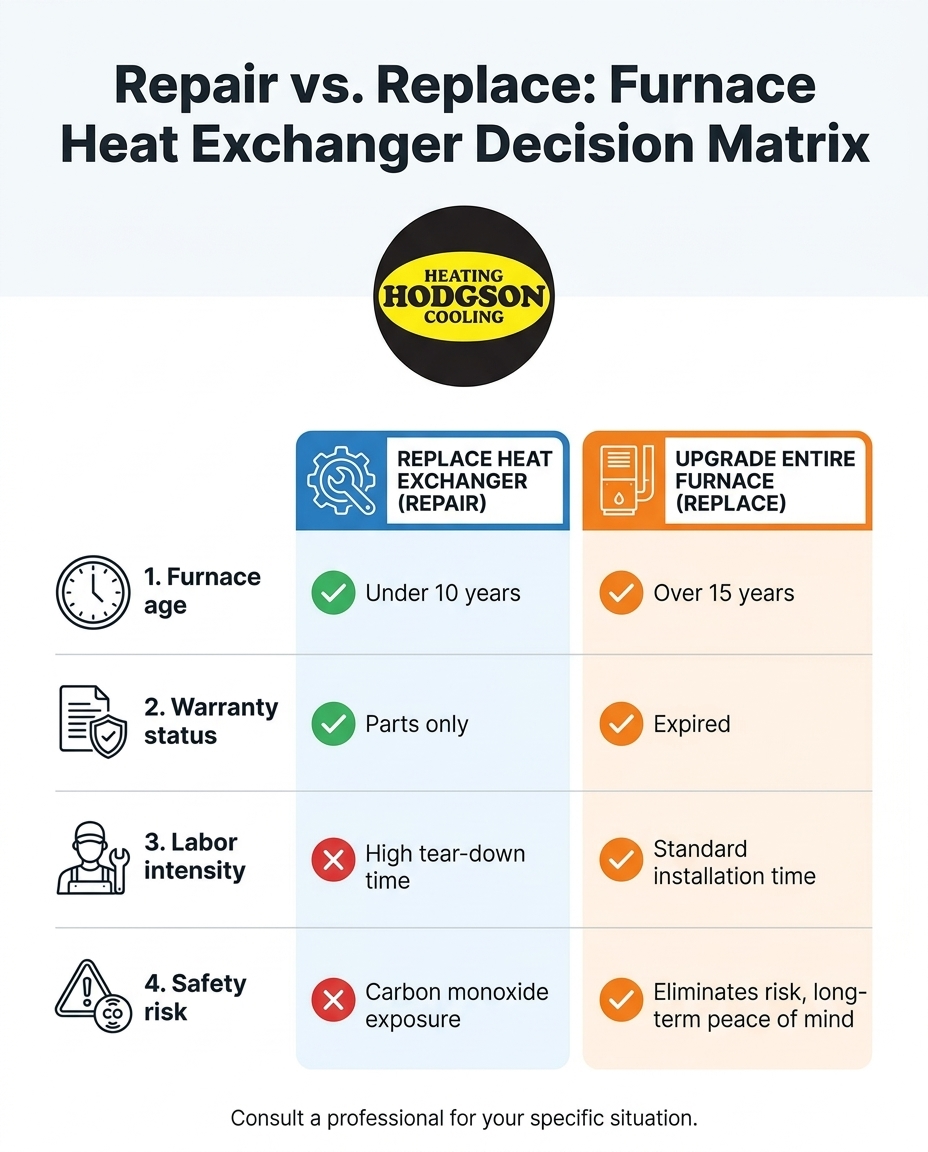
Side-by-Side Comparison: Repair vs. Replace Decision Matrix
To help you weigh your options objectively, we have broken down the cost-benefit analysis of both paths. Reviewing this matrix can clarify which choice aligns best with the age of your system and your long-term goals for Battle Creek MI area homes.
• Initial Investment — Repairing the Heat Exchanger: High labor investment; part may be free if under warranty, but labor is extensive. — Upgrading the Entire Furnace: Higher upfront investment for the equipment and installation.
• Warranty Coverage — Repairing the Heat Exchanger: Only the new heat exchanger is covered; aging surrounding parts remain vulnerable. — Upgrading the Entire Furnace: Comprehensive parts and labor warranties on the entire brand-new system.
• Long-Term Reliability — Repairing the Heat Exchanger: Moderate to low on older units; risk of subsequent component failures remains high. — Upgrading the Entire Furnace: Maximum reliability; guaranteed performance throughout the harsh winter season.
• Energy Efficiency — Repairing the Heat Exchanger: Maintains the current efficiency rating of your aging system. — Upgrading the Entire Furnace: Significant efficiency gains; potential eligibility for energy rebates and tax credits.
• Best Scenarios — Repairing the Heat Exchanger: Furnace is under 5-8 years old, fully under warranty, and in otherwise pristine condition. — Upgrading the Entire Furnace: Furnace is over 10-12 years old, out of labor warranty, or has a history of breakdowns.
Why Objective Safety Evaluations Matter More Than a Quick Sale
A cracked heat exchanger diagnosis should never be delivered with high-pressure sales tactics. Because this is a severe safety hazard, some unscrupulous contractors use the threat of carbon monoxide to force homeowners into immediate, panicked replacements without showing proof of the failure.
A reputable, certified professional will always prioritize your household's safety over upselling. When our Hodgson Heating & Cooling technicians find a crack during a September pre-winter tune-up, they utilize specialized tools—such as combustion analyzers and digital inspection cameras—to physically show you the damage or the irregular gas readings. You deserve visual proof and a thorough, easy-to-understand explanation of the problem.
Working with a reputable Daikin Comfort Pro dealer ensures you receive objective, consultative guidance. A true professional will present all viable options, including the exact labor reality of repairing the unit, and let you decide what fits your long-term goals. Your safety is non-negotiable, but how you choose to restore your heating system should remain entirely in your control.
Frequently Asked Questions
Is it worth replacing a heat exchanger on a furnace?
The short answer is that it depends heavily on the age and warranty status of your furnace. If your system is under eight years old and the part is fully covered by a manufacturer warranty, the labor investment to replace it is often worth it. However, if the furnace is over 12 years old, putting a massive amount of labor into an aging system usually leads to diminishing returns, as other major components are likely to fail soon.
Can you just replace a cracked heat exchanger?
Yes, you can physically replace a cracked heat exchanger, but it is never a simple, quick fix. Because the heat exchanger is the central core of the furnace, the technician must completely dismantle the blower, burners, and exhaust systems to remove the broken part. This makes the replacement incredibly labor-intensive and requires rigorous safety testing during reassembly to ensure no carbon monoxide can escape.
How dangerous is a cracked heat exchanger?
A cracked heat exchanger is considered a severe safety emergency because it allows carbon monoxide to leak directly into your home's air supply. Carbon monoxide is a colorless, odorless, and tasteless gas that can cause serious illness or fatalities if inhaled over time. If a crack is confirmed, the furnace must be shut down immediately and cannot be safely operated until the core is repaired or replaced.
Does a warranty cover heat exchanger replacement labor?
Most standard manufacturer warranties cover the cost of the physical heat exchanger part itself, but they rarely cover the extensive labor required to install it. Because replacing this component requires tearing down the entire furnace cabinet, the labor investment is substantial. Unless you have an active, extended labor warranty specifically tied to your installation, you will be responsible for the labor portion of the repair.
What are the symptoms of a cracked secondary heat exchanger?
The most common symptoms include a strong, unpleasant odor resembling formaldehyde near the furnace, pooling water around the base of the unit, and frequent system lockouts. You might also notice a change in the color of your burner flames—from a crisp blue to a lazy, flickering yellow or orange. Because a secondary heat exchanger handles acidic condensation, corrosion is often visible on the exterior of the component during a professional inspection.
How long does it take to replace a furnace heat exchanger?
Replacing a furnace heat exchanger typically takes a certified HVAC technician anywhere from four to eight hours to complete. The exact timeframe depends on the accessibility of the furnace, the specific make and model, and whether it is a primary or secondary unit. The process requires careful dismantling, precise installation of the new core, and extensive combustion safety testing before the system can be turned back on.
Making the Right Choice for Your Home
Deciding between replacing a cracked heat exchanger versus upgrading the entire furnace is a major decision, but you don't have to make it alone. By understanding the labor involved and prioritizing your household's safety, you can make an informed, confident choice. Our team at Hodgson Heating & Cooling is here to provide a clear, safety-first framework for making the repair versus replace decision, ensuring your home stays warm and secure all winter long.


