

Why We Recommend Running Your Modulating Furnace Fan Continuously During Battle Creek Summers
The Stagnant Air Dilemma: Fighting Late-Summer Heat
Your air conditioner just cycled off, and almost immediately, the air in your living room begins to feel heavy and warm. If you are wondering why we recommend running your modulating furnace fan continuously during Battle Creek summers, the answer comes down to solving this exact problem of stagnant indoor air. When the cooling cycle ends, the natural airflow in your home stops. The cold air sinks to the basement, the hot air rises to your second-floor bedrooms, and the overall comfort of your home quickly deteriorates.
This leaves homeowners facing a common decision point at the thermostat: do you leave the fan setting on "Auto," where it only runs alongside the outdoor compressor, or do you switch it to "On" to keep the indoor air circulating? For many, the immediate hesitation is the utility bill. There is a widespread, lingering fear that running any HVAC component 24/7 will cause a massive spike in energy costs. However, modern heating and cooling technology has fundamentally changed how we manage indoor airflow.
One Battle Creek homeowner reached out to us during a stifling 89-degree heat wave when their AC simply wasn't cooling the house evenly. A technician arrived quickly, provided updates throughout the diagnostic process, and had the system repaired and running efficiently within an hour and a half. Often, achieving that level of consistent comfort requires more than just a functioning compressor—it requires smart airflow management. If you are struggling with uneven temperatures, scheduling professional AC service in Battle Creek is the first step toward optimizing your system's performance.
A Tech's Perspective: What We Learned on a Sunday Service Call
To understand why continuous circulation works, it helps to look at how professionals diagnose airflow issues in the field. During a recent Sunday service call, Tech Tim encountered a very typical late-summer scenario: a homeowner frustrated by a house that felt sticky and warm, despite the thermostat reading the correct temperature. The natural assumption is often that the system is low on refrigerant or that a major component is failing.
However, field diagnostics frequently reveal that uneven cooling isn't always a mechanical failure outside. Instead, it is often an airflow distribution problem inside. When our technicians evaluate a home, they look for specific patterns. They measure the temperature differential between the supply registers and the return grilles, and they map out the hot and cold spots across different levels of the house. In many cases, the outdoor unit is doing its job perfectly, generating plenty of cold air. The failure happens because that cold air isn't being mixed properly with the ambient room air.
During these diagnostic visits, checking the thermostat's fan settings is a critical step. A typical pattern we see is a high-efficiency system being held back by an "Auto" fan setting that allows the air to stagnate between cooling cycles. Our team prioritizes personalized, on-the-ground technical reassurance, taking the time to teach homeowners how to use their existing equipment better. By explaining the methodology behind continuous airflow, we help families maximize their comfort through smart operation rather than jumping straight to unnecessary parts replacement.
The Utility Bill Myth: Why Continuous Circulation Doesn't Have to Cost a Fortune
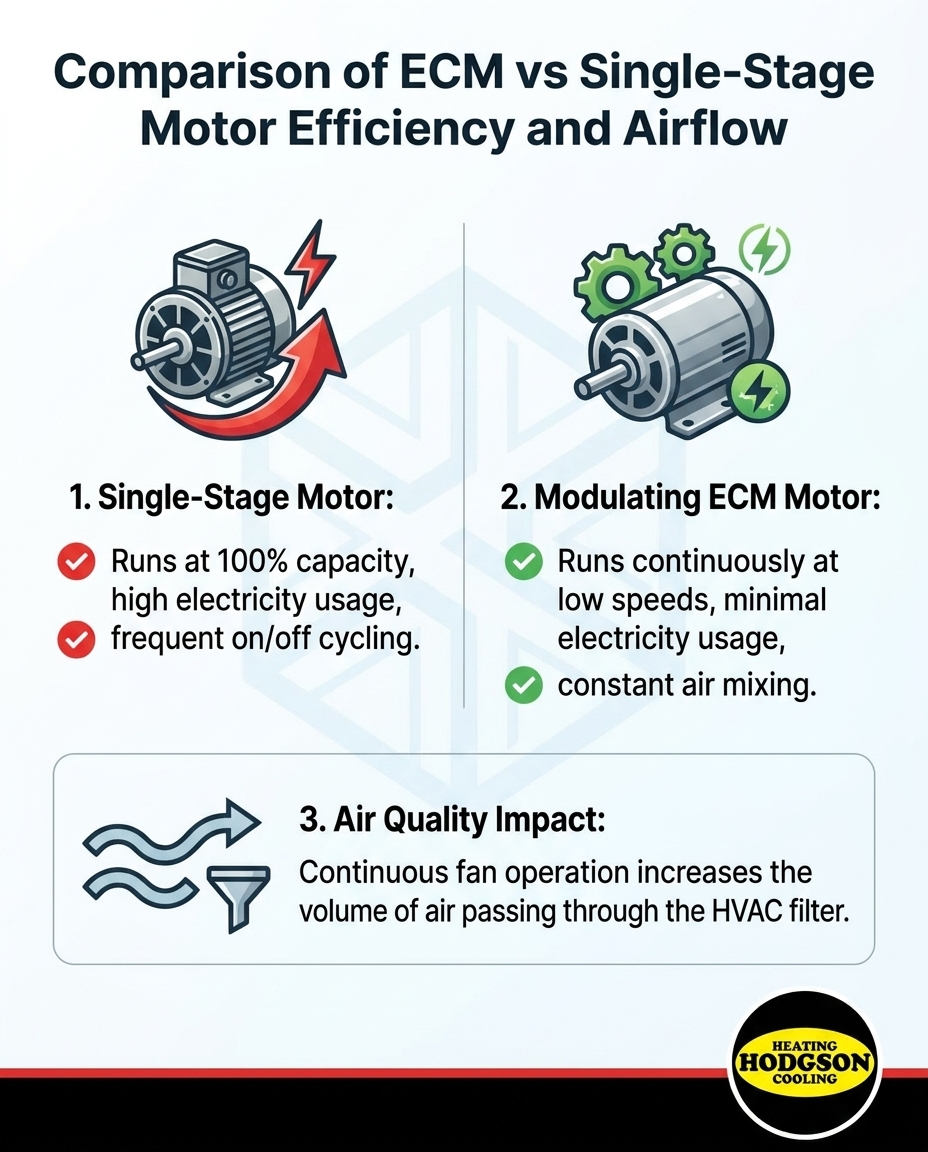
The primary reason homeowners hesitate to switch their thermostat fan to "On" is the fear of high electricity costs. This fear is entirely justified if you are basing it on older technology. For decades, standard furnaces were built with single-stage blowers, specifically Permanent Split Capacitor (PSC) motors. These older motors were notorious energy hogs. When they turned on, they ran at 100% capacity, consuming a significant amount of electricity just to move air. Running a PSC motor continuously would indeed result in a noticeable penalty on your monthly utility bill.
Today's modern HVAC systems use a completely different technology. The solution to the energy consumption problem is the Electronically Commutated Motor, commonly known as an ECM or a modulating variable-speed blower motor. Unlike older models, an ECM uses built-in inverters and magnetic rotors to operate at a fraction of the electrical usage when running at low speeds. It gently sips electricity, allowing the fan to maintain constant air movement without the heavy energy draw of a traditional motor.
This counterintuitive strategy is designed specifically for efficiency. By running the fan continuously at a low speed, the ECM constantly mixes the air in your home. This prevents the severe temperature fluctuations that force your outdoor AC compressor—the true energy consumer in your HVAC system—to turn on and off repeatedly. Reducing those hard starts saves energy and is a key component in resolving AC temperature inconsistencies.
Single-Stage vs. Modulating Motors
Understanding the mechanical differences between these two types of blower motors is essential for making informed decisions about your thermostat settings.
• Single-Stage (PSC) — Operational Speed: Always 100% (On or Off) — Energy Consumption: High electricity usage — Best Thermostat Setting: "Auto" only
• Modulating (ECM) — Operational Speed: Variable (Low, Medium, High) — Energy Consumption: Minimal at low speeds — Best Thermostat Setting: "On" for continuous mixing
How Your Heating Equipment Enhances Your Summer Cooling
There is a common psychological barrier for many homeowners when it comes to HVAC systems: the idea of using a "furnace" component during the peak of summer feels wrong. However, central heating and cooling systems are deeply integrated. The indoor blower motor, which sits inside your furnace cabinet, is a shared component. It is responsible for pushing heated air through your ducts in December, and it is equally responsible for pushing conditioned, cooled air through those same ducts in August.
Another local customer called us recently when their central air needed professional attention. During the visit, the technician not only executed the necessary AC repair but also serviced the furnace professionally on the same day. This holistic approach is crucial because the performance of your air conditioner relies entirely on the health of your furnace's blower motor and the cleanliness of its filter.
When you set a modulating ECM motor to run continuously, it utilizes that shared blower to create a steady, low-speed airflow throughout the house. This constant mixing eliminates the hot spots that typically plague upstairs bedrooms and the cold spots that make basements uncomfortable. The air is continuously pulled from the rooms, drawn down the return ducts, pushed past the cold evaporator coil, and redistributed.
The efficiency benefit: This constant mixing prevents the AC compressor from having to short-cycle. When air stagnates, localized temperature spikes around the thermostat can trick the system into turning the power-hungry outdoor compressor on and off rapidly. Continuous fan operation stabilizes the ambient temperature, allowing the compressor to run in longer, more efficient cycles when cooling is actually needed.
Battling Stagnant Air and High Humidity in Michigan Homes
The advice to run your fan continuously becomes especially relevant when we look at the specific indoor climate challenges created by our regional weather patterns. August in Battle Creek brings a unique combination of late-summer heat and high humidity. While the outdoor temperatures might occasionally dip into the upper 70s, the moisture in the air remains thick. This creates a specific problem indoors.
When the outdoor temperature isn't excessively hot, your air conditioner's compressor doesn't need to run very often to meet the temperature set on your thermostat. However, because the compressor isn't running, it isn't actively removing moisture from the air. This leads to heavy, stagnant air pockets indoors. The house might read 72 degrees on the wall, but it feels clammy, sticky, and uncomfortable.
Continuous low-speed circulation is the most effective way to combat this specific Battle Creek late-summer humidity issue without overcooling your home. By keeping the modulating fan running, you maintain a consistent "wind chill" effect throughout the house. The moving air helps evaporate moisture from your skin, making you feel cooler and more comfortable even when the outdoor humidity remains high.
The comfort balance: It clarifies the critical relationship between airflow and humidity management. You don't have to crank your thermostat down to 68 degrees just to force the AC to turn on and remove humidity. Instead, leveraging the continuous air movement of your ECM motor helps maintain a consistent, comfortable feel across every room, regardless of what the late-summer weather is doing outside.
The Filtration Bonus: Cleaner Air Around the Clock
Beyond temperature balance, there is a significant secondary benefit to continuous fan operation that adds tremendous value to your home environment: improved indoor air quality. Many homeowners assume their HVAC filter is always cleaning the air. The reality is that air is only being filtered when it is actively moving through the system's return ducts and passing through the media filter.
According to general EPA guidelines on indoor air filtration, increasing the volume of air turnover in a home is one of the most effective ways to reduce indoor pollutants. When your thermostat is set to "Auto," the air in your home is only being filtered during active cooling cycles. In late summer, when the AC might only run for 15 minutes out of every hour, your air is sitting unfiltered for the other 45 minutes. Dust, pet dander, and allergens are allowed to settle on your furniture and floors.
Running a modulating fan continuously changes this dynamic entirely. Here is what happens when the air never stops moving:
• Constant turnover: The system continuously pulls ambient air through the return vents, significantly increasing the total volume of air passing through the filter each day.
• Suspended particle capture: Because the air is always moving, dust and allergens remain suspended in the air longer, giving the return ducts a chance to pull them in and trap them in the filter.
• Seasonal protection: This continuous filtration is especially beneficial during late summer and the back-to-school season, when pollen counts remain high and new germs are being brought into the home daily.
When to Stick to the 'Auto' Setting
While continuous circulation is a powerful tool for comfort, it is important to provide necessary caveats. This strategy is not a one-size-fits-all solution for every home. The "On" strategy is strictly recommended for homes equipped with variable-speed or modulating blower motors. If you try this with older equipment, you will likely be disappointed by the results.
We strongly advise homeowners with older, single-stage PSC motors to keep their thermostats set to "Auto." Running a single-stage motor 24/7 will lead to excessive energy consumption and unnecessary wear and tear on an aging system. If you aren't sure what type of motor is sitting inside your furnace cabinet, it is always best to have a professional evaluate the system during routine furnace service.
The re-evaporation factor: There is also one specific weather scenario where turning a modulating fan back to "Auto" makes sense. During periods of extremely high indoor humidity—such as after a heavy late-summer rainstorm—immediate moisture removal becomes the absolute priority. If you run the fan continuously immediately after the AC compressor shuts off, the air blowing over the wet indoor evaporator coil can sometimes pick that moisture back up and re-evaporate it into the house. If your home suddenly feels overly humid while the fan is running constantly, switch it back to "Auto" for a few days to let the system prioritize dehumidification.
Frequently Asked Questions About Summer Thermostat Settings
Should I run my furnace fan continuously in summer?
Yes, if you have a variable-speed or modulating ECM motor, running the fan continuously is highly recommended. It balances temperatures across different floors, eliminates hot and cold spots, and significantly improves indoor air quality by constantly filtering the air. However, if you have an older single-stage motor, you should leave it on "Auto" to avoid high electricity usage.
Will leaving my thermostat fan on increase my energy bill?
With a modern ECM motor, the energy use is minimal. These advanced motors are designed to sip electricity at low speeds, often using less power than a standard lightbulb. Conversely, older single-stage motors will use significantly more electricity if left on continuously, which is why identifying your motor type is crucial before changing your settings.
Does running the furnace fan in summer help cool the house?
It doesn't actively cool the air, as the outdoor AC compressor is responsible for removing heat. However, it distributes the conditioned air from the AC much more evenly throughout the home. By constantly mixing the air, it eliminates stagnant hot spots in upstairs bedrooms and makes the entire house feel cooler and more comfortable.
How can I tell if I have a modulating furnace fan?
The easiest way is to check your equipment manual or look for terms like "variable speed" or "ECM" printed on the furnace unit itself. If you cannot locate this information, the safest approach is to have a local HVAC technician verify your motor type during your next routine maintenance visit.
Does leaving the AC fan on cause excess wear and tear?
Modulating motors are engineered specifically for continuous, low-speed operation. In many cases, running them continuously causes less wear and tear than constantly starting and stopping, which requires a surge of electricity and puts torque on the motor components. They are built for endurance and 24/7 circulation.
Enjoying Balanced Comfort for the Rest of the Season
Leveraging a modulating blower motor is a smart, highly efficient way to maintain comfort throughout the sticky, late-summer months. By understanding the technical differences between older single-stage blowers and modern ECM technology, you can confidently switch your thermostat to "On" without the fear of skyrocketing utility bills. The equipment is designed for this exact purpose: providing continuous, low-power operation to balance your home's temperature and keep your indoor air fresh and filtered.
If you are struggling with stagnant air, uneven cooling, or simply want to ensure your system is operating at its peak efficiency, you don't have to guess at the solutions. We encourage you to reach out if you are unsure about your system's capabilities or need help optimizing your airflow. Learn more about your options for dependable air conditioning and let our experienced team provide the clear, technical reassurance you need to keep your home comfortable all season long.


