

Bypass Versus Fan-Powered Whole-Home Humidifiers for Michigan Winters
Preparing Your HVAC for the Dry Season: Which Humidifier Fits Your Furnace?
Before the first hard freeze hits the Great Lakes region, there is a brief window to prepare your home for the brutal months ahead. Evaluating bypass versus fan-powered whole-home humidifiers for Michigan winters is one of the most impactful decisions you can make during your mid-fall pre-winter startup. Once the temperatures drop and your furnace begins running around the clock, the air inside your home will rapidly lose its natural moisture.
Michigan winters cause indoor humidity to plummet because sub-freezing outside air contains very little moisture. When that cold air infiltrates your house and is heated by your furnace, the relative humidity drops even further. Maintaining an indoor relative humidity between 40% and 60% is necessary to protect respiratory health, prevent hardwood floors and antique furniture from cracking, and allow you to feel warmer at lower thermostat settings.
Many homeowners initially try to solve this problem with standalone room humidifiers. The short answer is that portable units simply cannot keep up with the constant drying effect of a central heating system. They require daily refilling, only treat isolated spaces, and often become breeding grounds for mold if not cleaned meticulously.
Choosing to install a whole-home system directly into your ductwork solves the problem house-wide. However, finding the right fit depends heavily on your home's existing ductwork, your tolerance for ongoing maintenance, and your preferences regarding utility usage. At Hodgson Heating & Cooling, we have helped countless families navigate this exact choice. Based on our extensive installation history across the region, manufacturer specification sheets rarely tell the whole story for local homes. Field-tested experience reveals that the choice between a bypass and a fan-powered unit requires a closer look at how each system actually operates within your specific HVAC setup.
How Furnace-Dependent Bypass Humidifiers Operate
To understand which system is right for your home in Battle Creek, MI, our technicians always start by explaining the mechanics of how these units generate and distribute moisture. A bypass humidifier is the most common type of whole-home system we install, largely because of its straightforward, reliable design.
These units do not possess their own internal motor. Instead, they rely entirely on your furnace's blower motor to push air through a moistened water panel (often called an evaporator pad). They operate using the natural pressure differences within your HVAC ductwork.
The Step-by-Step Operation of a Bypass Unit
1. The Heating Cycle Begins: The humidifier only activates when your furnace is actively heating your home. Once the thermostat calls for heat, the furnace blower turns on.
2. Water Flows to the Panel: A solenoid valve opens, allowing a slow, steady trickle of water to flow over the internal water panel.
3. Air is Bypassed: Because the supply duct (pushing hot air out) has higher pressure than the return duct (pulling cold air in), air is forced through a custom-installed bypass tube that connects the two sides.
4. Moisture is Absorbed: As the hot air passes through the wet panel inside the bypass tube, it absorbs moisture through evaporation.
5. Distribution: The newly humidified air enters the return duct, passes through the furnace to be heated further, and is distributed evenly throughout the entire house.
Because bypass humidifiers operate exclusively when the furnace is running, their moisture output is tied directly to your heating cycles. This design offers distinct advantages. With fewer electrical components and no internal fan motor, our team typically sees far fewer breakdowns over time. They also operate almost silently, as the only noise generated comes from your existing furnace blower.
The Independent Mechanics of Fan-Powered Humidifiers
At Hodgson Heating & Cooling, we often tell customers that if a bypass unit is a passenger riding along with your furnace, a fan-powered humidifier is an independent vehicle. These systems are designed for higher output and greater control, making them a frequent choice during mid-fall pre-winter startup for larger properties or homes that struggle to retain moisture.
The internal fan: The defining feature of a fan-powered unit is its built-in electric fan. Instead of relying on the pressure differential between your supply and return ducts, this unit actively blows air across the water panel itself.
Independent operation: Because it has its own motor, a fan-powered humidifier does not need the furnace to be in a heating cycle to operate. As long as your HVAC system's main blower is running (even just on the "fan only" setting), the humidifier can actively push moisture into the airstream. This allows for much more precise humidity control, especially on unseasonably mild winter days when your furnace isn't running frequently but the air remains exceptionally dry.
Higher moisture capacity: Fan-powered models are heavy lifters. A standard unit can produce upwards of 18 gallons of moisture daily. This makes them highly effective for homes with larger square footage, vaulted ceilings, or drafty windows that constantly leak dry air indoors.
The primary trade-off for this increased performance is mechanical complexity. The internal fan motor adds an electrical component that our technicians must inspect during routine seasonal maintenance. While highly reliable, any motorized part adds a slight potential for future wear and tear compared to the motor-less bypass design.
Water Usage vs. Electrical Demand: Weighing the Tradeoffs
One pattern our team sees often is homeowners focusing solely on the upfront installation process without considering the long-term resource footprint of their new system. Both units consume resources, but they do so in completely different ways. You must weigh your local utility costs and environmental preferences when deciding between the two.
The Water Waste of Bypass Units
Bypass humidifiers are technically less efficient with water. Because evaporation is a slow process, the solenoid valve must continuously run a trickle of water over the panel while the furnace operates. The air absorbs what it can, but a significant portion of that water never evaporates. Instead, it flows straight down through the pad and into a floor drain. For homeowners in Battle Creek, MI, who are highly conscious of their water footprint or who operate on a private well system with limited yield, this continuous drain usage is a factor worth considering.
The Electrical Demand of Fan-Powered Units
Fan-powered units are generally much more efficient with water usage. Because the internal fan aggressively forces air across the panel, a higher percentage of the water is successfully evaporated into the airstream, resulting in far less runoff down the drain. However, this efficiency comes at the cost of electricity. The independent motor requires power to run, adding a slight increase to your electrical draw during the winter months.
Neither unit creates a massive, budget-breaking spike in utility bills. The electrical draw of a fan-powered unit is roughly equivalent to leaving a standard lightbulb on, and the water usage of a bypass unit is a fraction of what a lawn sprinkler uses. However, understanding whether you prefer to conserve water or conserve electricity will help guide your final decision.
Maintenance Realities: Hard Water and Scale Buildup
Manufacturer spec sheets often assume ideal, perfectly balanced water conditions. In our decades of field-tested experience installing and servicing these systems throughout the Battle Creek area, the Hodgson Heating & Cooling team has found that local water quality changes the maintenance frequency dramatically. Hard water is a reality for many properties in our service area, and it plays a major role in how both types of humidifiers age over time.
The problem with hard water: Local water supplies often contain high levels of dissolved minerals, specifically calcium and magnesium. When water evaporates inside your humidifier, it leaves these heavy minerals behind. Over a single winter season, this creates a crusty, white mineral scale buildup on the water panel.
Impact on bypass humidifiers: Because bypass units have very few moving parts, they handle hard water scaling relatively well. The scale accumulates almost entirely on the replaceable water panel and the plastic housing. As long as the homeowner replaces the panel annually (or twice a season for very hard water), the unit continues to function perfectly. There is no internal motor for the scale to damage.
Impact on fan-powered humidifiers: Hard water poses a slightly higher risk to fan-powered units. If maintenance is neglected and mineral scale is allowed to build up excessively, it can eventually impede the operation of the internal fan motor. The fan blades and housing require careful inspection during annual tune-ups to ensure that scale hasn't accumulated to the point of causing friction or motor strain. We generally recommend that if your home has exceptionally hard water and no whole-home water softener, a bypass unit will simplify your long-term upkeep.
Ductwork Constraints and Historic Home Considerations
Even if you have a strong preference for one type of humidifier, your home's physical architecture might make the decision for you. When our installers arrive on-site, the ductwork layout is the ultimate deciding factor in what can be safely and effectively installed.
Bypass humidifiers require enough physical space on the ductwork to install the bypass tube. This is typically a 6-inch round pipe that must route from the supply plenum over to the return plenum. In spacious, modern basements, this is rarely an issue. However, older homes with retrofitted HVAC systems often face unique ductwork constraints. If your furnace is tucked into a tight utility closet, a crawlspace, or an attic, there simply may not be enough physical clearance to route the bypass tubing without sharp, restrictive bends.
Fan-powered units offer a distinct space-saving advantage in these scenarios. Because they do not require a bypass tube connecting the two sides of the ductwork, they mount directly to the supply plenum. They only need enough flat surface area on one side of the furnace to accommodate the unit itself.
For homeowners managing humidity in Battle Creek's historic homes, a professional assessment of the plenum space is absolutely required before committing to a model. A licensed Hodgson Heating & Cooling technician must evaluate the static pressure of your ductwork and the available physical dimensions to ensure the chosen unit will operate safely without suffocating your furnace's airflow.
Side-by-Side Comparison: Bypass vs. Fan-Powered Pros and Cons
To help you synthesize this information before your mid-fall pre-winter startup, here is a direct comparison of the key tradeoffs between the two systems based on what we see in the field.
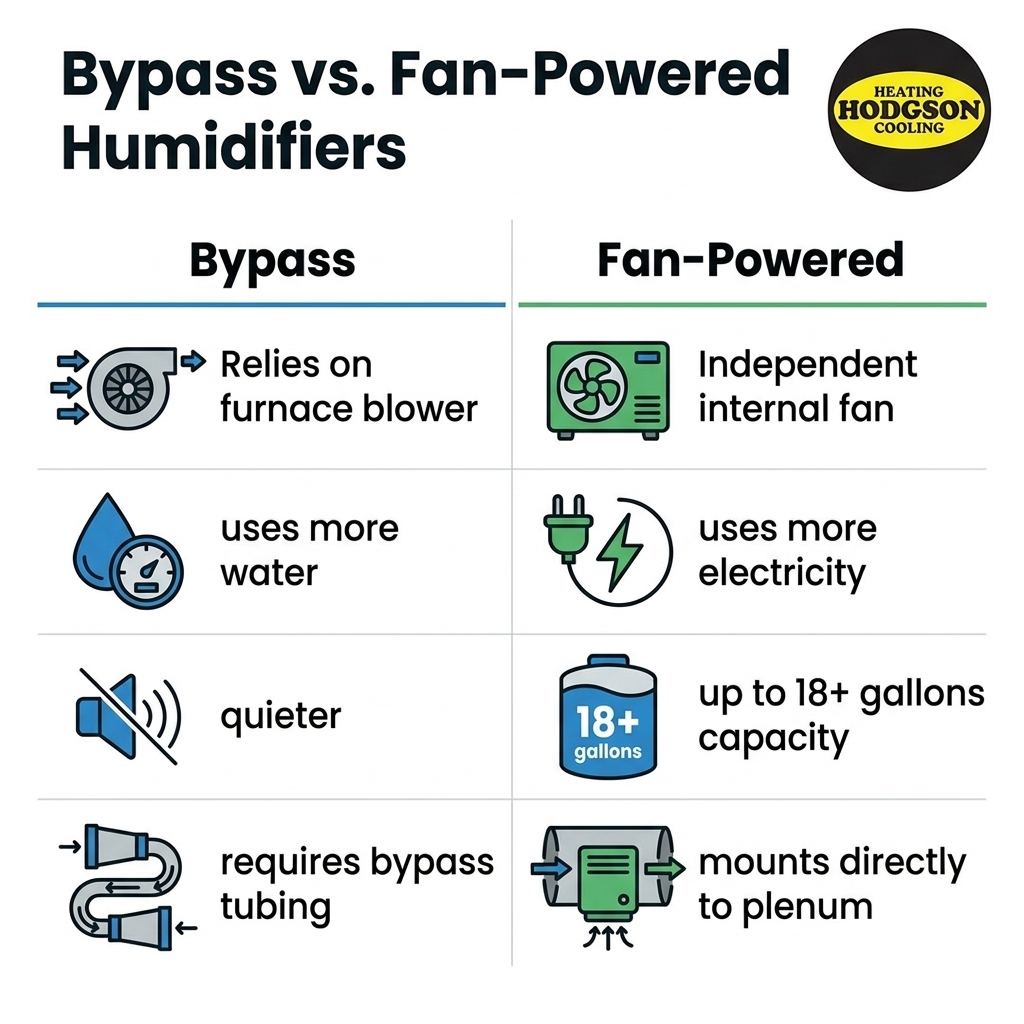
• Moisture Output — Bypass Humidifiers: Moderate (sufficient for average-sized homes) — Fan-Powered Humidifiers: High (up to 18+ gallons daily; ideal for large homes)
• Operation — Bypass Humidifiers: Relies entirely on the furnace heating cycle — Fan-Powered Humidifiers: Independent internal fan; operates anytime blower runs
• Resource Usage — Bypass Humidifiers: Uses more water (excess drains away) — Fan-Powered Humidifiers: Uses more electricity (to power the internal motor)
• Installation Space — Bypass Humidifiers: Requires space for 6-inch bypass tubing — Fan-Powered Humidifiers: Mounts directly to supply plenum; space-saving
• Maintenance — Bypass Humidifiers: Low mechanical risk; easily handles hard water scale — Fan-Powered Humidifiers: Requires inspection of fan motor for scale buildup
• Noise Level — Bypass Humidifiers: Virtually silent — Fan-Powered Humidifiers: Produces a low hum from the internal fan
Frequently Asked Questions About Whole-Home Humidifiers
Which whole-home humidifier is better: bypass or fan-powered?
The better choice depends entirely on your home's size, ductwork, and water conditions. Fan-powered humidifiers are generally better for larger homes because they produce significantly more moisture and operate independently of the heating cycle. Bypass humidifiers are often preferred for average-sized homes in Battle Creek, MI, because they have fewer moving parts, operate silently, and are highly reliable even in areas with hard water.
Do bypass humidifiers waste water?
Yes, bypass humidifiers do send a portion of their water down the drain. Because they rely on a slow evaporation process, water continuously trickles over the internal panel while the furnace runs, and whatever is not absorbed by the air flows into a floor drain. While it is not a massive volume of water, homeowners on private wells or those strictly monitoring their water usage should be aware of this continuous flow.
Do fan-powered humidifiers use a lot of electricity?
No, fan-powered humidifiers do not use a significant amount of electricity. The internal fan motor is relatively small and draws roughly the same amount of power as a standard household lightbulb. While they do use more electricity than a bypass unit (which uses almost none), the impact on your monthly winter utility bill is generally negligible compared to the comfort benefits they provide.
What are the maintenance differences between bypass and fan-powered humidifiers?
The primary maintenance difference comes down to mechanical complexity. Both units require you to change the internal water panel at least once a season. However, fan-powered units require an additional step: a technician must inspect the internal fan motor and housing to ensure hard water mineral scale has not built up on the moving parts. Bypass units lack this motor, making their long-term upkeep slightly simpler.
Can I install a whole-house humidifier myself?
No, installing a whole-home humidifier is not a DIY project. The installation requires cutting directly into your home's central ductwork, tapping into your plumbing lines for the water supply, and wiring the unit into your HVAC system's control board. A licensed professional must handle the installation to ensure the equipment operates safely, does not cause water damage, and does not void your existing furnace warranties.
Schedule Your Humidifier Installation Before Winter Hits
Don't wait until the deep freeze sets in to discover your home's air is uncomfortably dry. Once winter arrives and your furnace begins its constant operation, indoor humidity levels will drop rapidly, leading to dry skin, static shocks, and a home that feels colder than the thermostat reads. The best time to address this is during your mid-fall pre-winter startup.
Evaluating your existing ductwork, local water conditions, and square footage is the first step to choosing the right unit. Talk to an expert to weigh the maintenance and water usage tradeoffs for your specific home. Reach out to the team at Hodgson Heating & Cooling to schedule a professional assessment of your HVAC setup, and ensure your home is equipped with the right humidification system long before the harsh Michigan winter takes hold. Also, be sure to ask us if any local utility incentive programs or generic rebates apply to your qualifying indoor air quality upgrades.


