

How Blocked Return Vents Quietly Suffocate Your Blower Motor
The Hidden Danger of Fall Furniture Rearrangement
You just finished rearranging the living room for the upcoming holidays, but if you aren't careful, you might soon discover how blocked return vents quietly suffocate your blower motor. At Hodgson Heating & Cooling, we see this happen every year during the mid-fall heating startup or early winter. Homeowners push a heavy sofa against a wall, unroll a thick new area rug, or set up seasonal decorations without realizing they just covered a critical part of their home's breathing system. A few days later, the house feels chilly, the furnace is acting strange, and panic sets in.
Before you assume your heating system has suffered a total mechanical failure, you need to look at your room layout. Inadvertently covering your cold air returns creates a massive bottleneck for your HVAC system. When your furnace cannot pull in enough air, it cannot push out enough heat. Worse, this restriction creates intense mechanical strain that can destroy expensive internal components long before their time.
This is especially critical in our region. With rapid temperature drops in Battle Creek making sudden furnace short-cycling highly noticeable and urgent, a suffocating system becomes an immediate comfort crisis. A sudden cold snap is the worst possible time to lose your heat. Recognizing that your sudden early-winter furnace shutdown might just be a furniture layout issue gives you a concrete decision point. You can check your vents, clear the blockages, and potentially save yourself an emergency service call.
The quick fix: Walk through every room in your house and locate your large return grilles. If you cannot see them clearly, your furnace cannot breathe properly.
The Anatomy of Airflow: Supply vs. Return Vents
To understand why covering a single grille causes so much trouble, you have to understand how air moves through your home. Your heating and cooling system operates on a closed loop. It does not create new air; it simply conditions the air that is already inside your house and circulates it continuously. This circulation relies entirely on two distinct types of vents: supply and return.
Supply vents are the smaller registers you usually find under windows, along baseboards, or in the ceiling. These are the vents that blow heated or cooled air into your living spaces. Return vents, on the other hand, pull the existing room-temperature air back into the ductwork so the furnace can heat it again. Return vents are typically much larger than supply vents and are usually located on interior walls, in hallways, or centrally located on the floor.
• Primary Function — Supply Vents: Blows conditioned (heated/cooled) air into the room. — Return Vents: Pulls unconditioned air back into the HVAC system.
• Typical Size — Supply Vents: Smaller, often 4x10 or 4x12 inches. — Return Vents: Much larger, often 14x14, 20x20, or larger.
• Location — Supply Vents: Perimeter walls, under windows, ceilings. — Return Vents: Central hallways, interior walls, open floors.
• Airflow Direction — Supply Vents: Outward into the living space. — Return Vents: Inward toward the furnace and filter.
Many homeowners mistakenly believe that blocking a return vent is just like closing a supply register in an unused guest room. This is a dangerous misconception. If you are dealing with fall furnace startup troubleshooting, you must recognize that your blower motor relies on a massive, specific volume of return air. This incoming air does not just heat your home—it actually cools the internal components of the furnace itself.
Why Your Blower Motor Needs to Breathe
Your HVAC system operates on the principles of negative and positive pressure. The blower motor creates negative pressure on the return side to suck air in, and positive pressure on the supply side to push air out. When you block a return vent, you instantly increase the negative pressure in the return ducts.
Think of it like trying to drink a thick milkshake through a tiny cocktail straw. Your lungs have to work incredibly hard, but you still barely get anything out. When your furnace's return vents are blocked, the blower motor acts the same way. It spins faster and works harder to pull the required volume of air through a restricted opening. This excessive strain draws more electricity, generates excess friction, and leads directly to premature mechanical wear on the motor bearings and electrical windings.
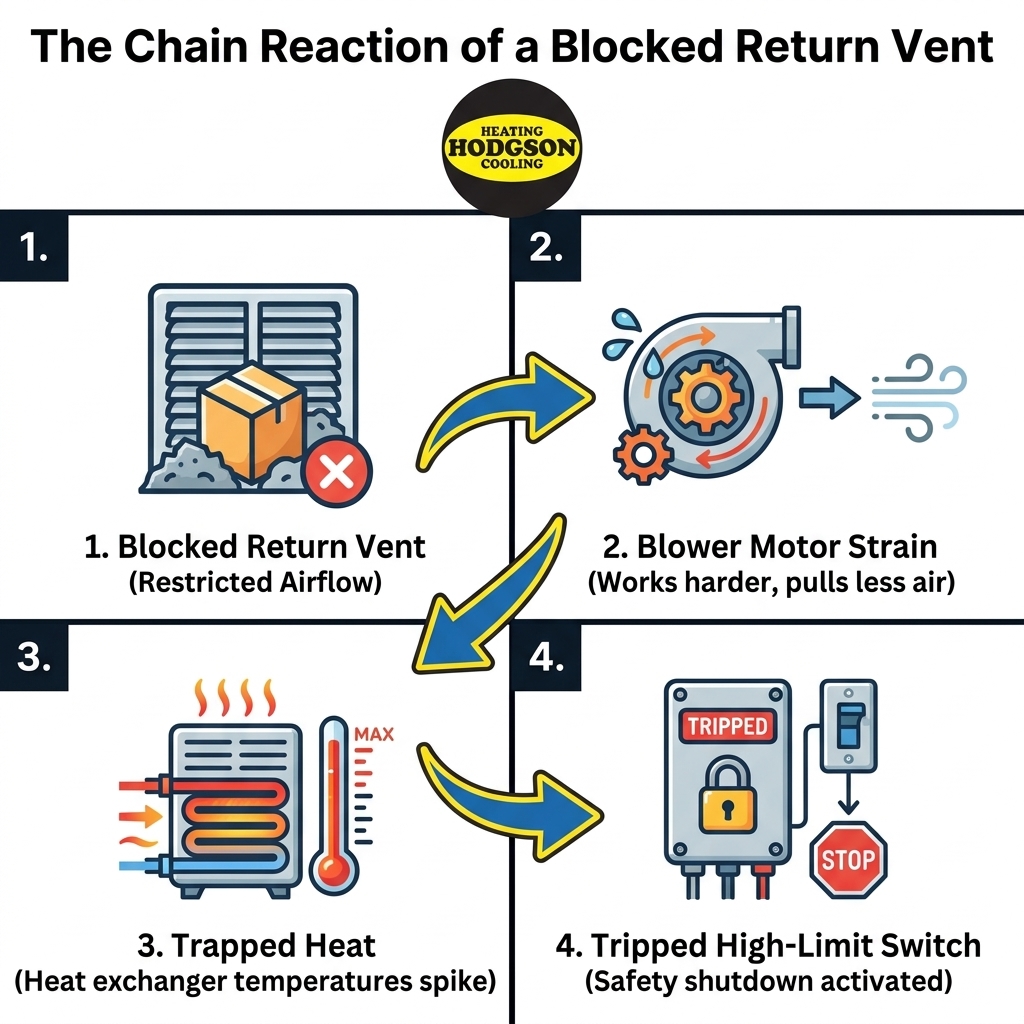
The Domino Effect: Overheating and the Tripped High-Limit Switch
The damage from restricted airflow does not stop at the blower motor. It triggers a dangerous mechanical chain reaction throughout the entire furnace. When the blower motor is starved for air, it cannot push enough air over the heat exchanger. The heat exchanger is the metal component inside your furnace that actually gets hot and transfers warmth to the air passing over it.
Without a constant, heavy flow of cold return air blowing across it, the heat exchanger cannot shed its heat. The temperature inside the furnace cabinet begins to spike rapidly. The metal gets hotter and hotter, trapping dangerous levels of thermal energy inside the unit.
This is where your system's safety controls take over. Every modern furnace is equipped with a high-limit switch. This critical safety device constantly monitors the temperature inside the furnace cabinet. Its sole job is to prevent catastrophic damage or a potential house fire. When internal temperatures reach dangerous levels due to poor airflow, the tripped high-limit switch immediately shuts down the burners to stop the heat production.
In our years of diagnosing early winter service calls throughout Battle Creek, our technicians at Hodgson Heating & Cooling find this specific chain reaction is one of the most frequent culprits. We often see perfectly good blower motors burn out prematurely simply because a piece of furniture was moved over a cold air return during pre-winter preparations. One homeowner reached out to us during a cold snap when they lost heat unexpectedly overnight. The house was freezing, and they assumed the furnace was completely dead. Our repair technician arrived earlier than scheduled, checked the system, and discovered that an airflow restriction had caused the system to overheat and shut down. By addressing the airflow and resetting the system properly, we got their heating system up and running again quickly.
Common Household Culprits Choking Your HVAC System
Most homeowners do not intentionally block their vents. It usually happens by accident during seasonal cleaning, remodeling, or decorating. Because return grilles are often large and unsightly, there is a natural temptation to hide them behind furniture. However, aesthetics should never overrule mechanical safety.
Here are the most common things our team finds choking HVAC systems:
• Couches and heavy seating: Pushing a large sectional or armchair flush against a wall return completely seals off the airflow. Even if the couch has short legs, the gap beneath it is rarely enough to allow proper air volume.
• Area rugs and new carpeting: Throw rugs are notorious for covering floor returns in hallways. Sometimes, during a renovation, flooring installers will even accidentally carpet right over a return vent opening.
• Holiday decorations and large plants: Artificial trees, large potted plants, and stacks of storage boxes are frequently placed in empty corners—which is exactly where many builders place return grilles.
• Drapes and heavy curtains: Long curtains hanging over a wall vent might look fine when the system is off. But when the blower motor kicks on, the negative pressure sucks the fabric tight against the grille, sealing it shut.
• Bookshelves and entertainment centers: Solid, heavy furniture pieces placed directly in front of large wall grilles create an impenetrable barrier for incoming air.
The golden rule of clearance: You must keep at least 10 to 12 inches of completely unobstructed space around all return grilles. This allows the air to flow freely from the room into the ductwork without creating turbulence or restriction.
Red Flags: Signs Your Furnace is Starving for Air
Your furnace will usually give you several warning signs before the blower motor fails completely. If you know what to look for, you can catch an airflow restriction early and correct the room layout before permanent damage occurs.
The most obvious symptom is short cycling. This happens when the furnace turns on, runs for just a few minutes, and then abruptly shuts off before the thermostat reaches your desired temperature. A few minutes later, it tries to start again, only to shut down once more. This continuous loop is the sound of your high-limit switch doing its job—shutting the system down as it overheats, waiting for it to cool, and then allowing it to try again.
Other red flags include an unusually hot furnace casing. If you touch the outside of your furnace cabinet in the utility room and it feels hot enough to burn you, the internal heat is not escaping properly. You might also notice strange burning smells, like hot metal or burning dust, coming from your vents. Additionally, if you hold your hand over a supply register and feel weak or barely noticeable airflow, it usually means the system is not pulling in enough air on the return side to push out on the supply side.
Sometimes, these airflow restrictions mask deeper, more complex issues. One local customer had a recurring furnace malfunction that caused endless frustration. The system kept failing during the winter. Our Hodgson Heating & Cooling technician spent extra time troubleshooting the entire airflow profile, ordered the necessary replacement parts to fix the strain damage, and successfully diagnosed the difficult problem, getting their heat restored promptly. Airflow issues can create incredibly confusing symptoms if you do not know exactly what to look for.
Diagnosing Short Cycling vs. Complete Failure
It is important to tell the difference between a temporary safety shutdown and a dead motor. If your furnace short cycles but the blower motor still hums and tries to push air, the motor is likely still alive but struggling against a restriction or overheating. If the furnace clicks on, the burners ignite, but the blower motor makes no sound at all and no air moves, the motor may have already failed.
Persistent short cycling requires immediate attention. Every time the limit switch trips, it causes wear and tear on the switch itself. Over time, a limit switch that trips constantly will weaken and eventually fail in the open position, leaving you with no heat at all until the part is replaced.
When to Clear the Vent and When to Call a Professional
As a homeowner, there are several safe, actionable steps you can take to resolve basic airflow issues before calling for emergency service. However, there are also strict boundaries regarding what you should never attempt to fix yourself.
1. Walk the house and clear the vents: First, check every single room. Pull couches away from the walls, roll back area rugs, and tie up long curtains. Ensure all return and supply vents are completely uncovered with that 10 to 12-inch clearance.
2. Check and replace the furnace filter: A severely clogged furnace filter mimics a blocked return vent perfectly. Both scenarios starve the blower motor of air. Pull your filter out and hold it up to a light. If you cannot see light through it, throw it away and install a clean one.
3. Monitor the system: Turn the thermostat up a few degrees and listen to the furnace. If it runs continuously until it reaches the set temperature without shutting down prematurely, you have likely solved the problem.
Crucial Warning: NEVER attempt to manually reset a tripped limit switch, open the blower compartment to bypass safety controls, or alter the internal wiring of your furnace. These safety mechanisms exist to prevent fires and carbon monoxide leaks. Bypassing them is incredibly dangerous and requires a licensed professional.
If clearing the vents and changing the filter does not stop the short cycling, professional diagnostics are required. Local professionals in Battle Creek MI, like our team at Hodgson Heating & Cooling, have the specialized tools to test the limit switch safely, measure the exact amp draw on your blower motor, and determine if the heat exchanger has suffered any stress cracks from the repeated overheating.
Protect Your Blower Motor Before the Deep Freeze
Taking a few minutes to check your room layout is the easiest and most cost-effective way to protect the mechanical health of your furnace. A simple walk-through to ensure your return vents are clear prevents the dangerous domino effect of starved blower motors, trapped heat, and tripped safety switches. It keeps your system running efficiently and keeps your energy bills under control.
There is immense satisfaction in knowing your heating system can breathe easily and operate safely throughout the entire winter. You can sleep soundly knowing your furnace is not struggling against a wall of heavy furniture or a forgotten area rug.
If your system has been short cycling, running unusually hot, or struggling to push air even after you have cleared all the vents and changed the filter, do not wait for a total breakdown. Reach out to a local expert, like our crew at Hodgson Heating & Cooling, for help with stubborn airflow or overheating issues. A thorough professional inspection now will ensure your home stays warm, safe, and comfortable long before the deep freeze sets in. Additionally, if your blower motor has already failed and your system is aging, upgrading to a high-efficiency unit might qualify for generic utility incentive programs or federal tax credits—be sure to verify current programs with your utility or tax professional.
Frequently Asked Questions
What happens if a return air vent is blocked?
Blocking a return vent starves your HVAC system of the air it needs to function. The blower motor has to work much harder to pull air through the restriction, which increases energy consumption and causes the internal components of the furnace to overheat rapidly.
Can blocked vents damage a furnace blower motor?
Yes, severely restricted airflow is a leading cause of premature blower motor failure. The motor is forced to spin faster and operate under intense negative pressure, which burns out the electrical windings and wears down the bearings long before their normal lifespan.
Why does my furnace keep shutting off after a few minutes?
This is called short cycling, and it usually happens when the furnace overheats. A safety device called the high-limit switch detects dangerous internal temperatures—often caused by blocked vents or a dirty filter—and shuts the system down to prevent a fire or mechanical damage.
How much clearance does a cold air return need?
You should maintain at least 10 to 12 inches of completely unobstructed space in front of and around every return vent. This ensures the blower motor can pull a sufficient volume of air into the ductwork without creating turbulence or strain.
Can a dirty furnace filter cause the same issues as a blocked vent?
Yes, a heavily clogged furnace filter creates the exact same mechanical problems as a blocked return vent. Both issues stop cold air from reaching the blower motor, leading to overheating, short cycling, and potential system failure.


