

Upgrading to a Wi-Fi Thermostat: Convenience Versus Privacy and Compatibility Tradeoffs
The Myth of the Plug-and-Play Smart Home Upgrade
Most homeowners believe swapping out a temperature control is a simple, ten-minute weekend project, but when considering upgrading to a Wi-Fi thermostat: convenience versus privacy and compatibility tradeoffs quickly take center stage. At Hodgson Heating & Cooling, we see this scenario play out frequently. You buy a sleek new device, pop the old faceplate off the wall, and immediately hit a roadblock: the wiring behind your wall doesn't match the instructions in the box. Instead of enjoying remote temperature control, you are left staring at a handful of colored wires while your house slowly gets colder.
As you focus on November pre-winter readiness, the last thing you want is a half-finished electrical project leaving your home without reliable heat. The decision to modernize your home's climate control is rarely as straightforward as the marketing suggests. You have to weigh the undeniable appeal of automated scheduling against the technical realities of your existing equipment, the privacy implications of internet-connected sensors, and the potential need for professional rewiring.
If you are struggling with your heating systems or need reliable furnace service in Battle Creek, our team is here to help.
Before you commit to a smart home upgrade, it is critical to look past the glossy packaging. Understanding exactly what these devices require to function safely—and what data they collect while doing so—will help you make a confident, informed decision about whether a Wi-Fi connected unit is truly the right fit for your home.
The Appeal of Convenience: Remote Access and Geofencing
There is a reason Wi-Fi thermostats have become incredibly popular. The features they offer provide a level of control that traditional programmable units simply cannot match. For many homeowners, the ability to manage their home's climate from anywhere in the world is a game-changer for both comfort and energy efficiency.
However, these conveniences rely heavily on a constant, uninterrupted power supply and a stable internet connection. Our team knows that if you live in one of the many older Battle Creek homes, achieving that stable power connection is often the first major hurdle. When the setup is fully compatible, the benefits are substantial.
Key conveniences driving the smart thermostat upgrade:
• Remote climate management: Whether you are at the office, on vacation, or just lying in bed, you can adjust the temperature using a smartphone app. This eliminates the need to walk over to the hallway control panel every time you feel a draft.
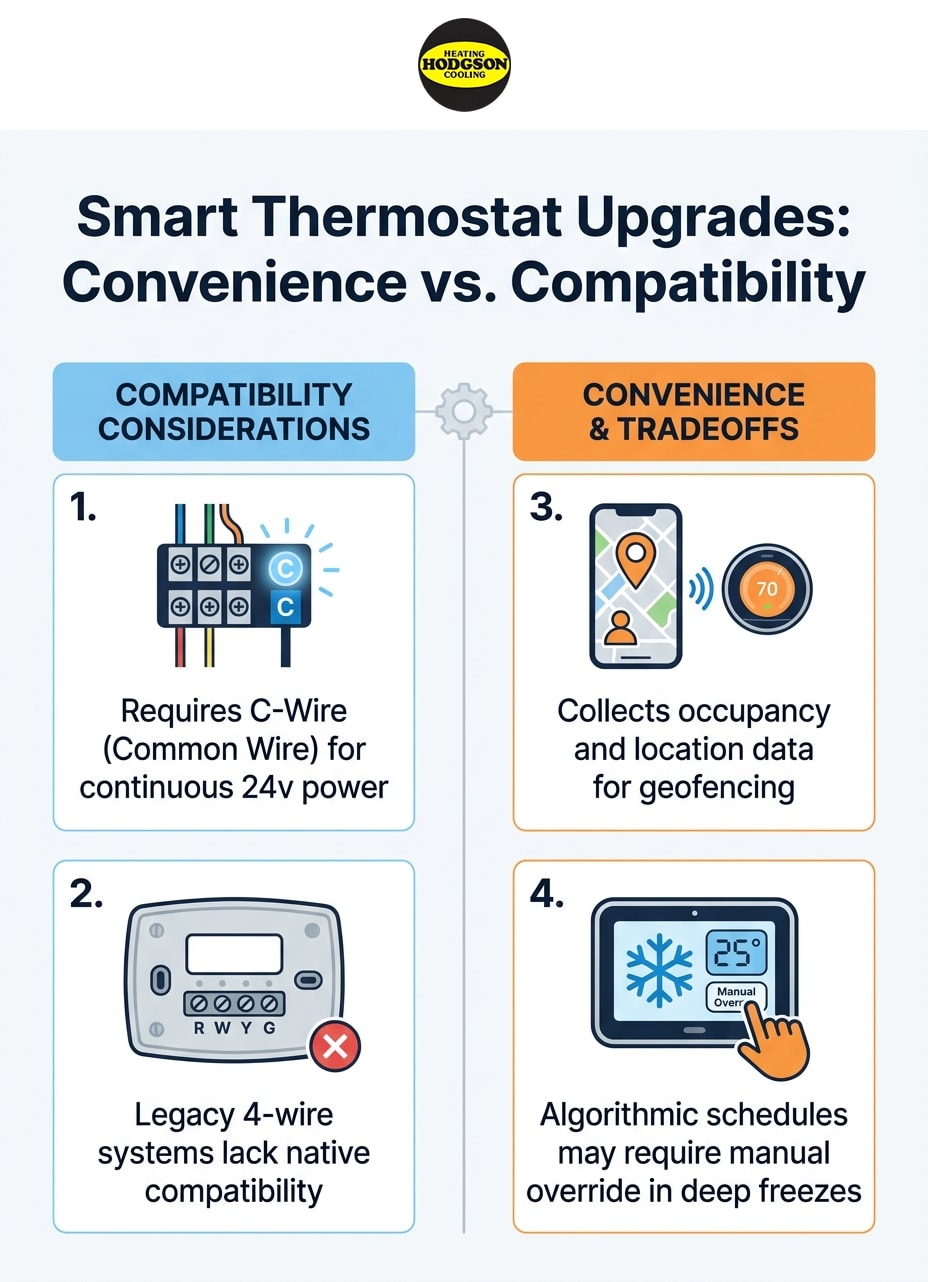
• Automated geofencing: This feature tracks your smartphone's location. When you leave a designated perimeter around your house, the system automatically dials back the heating or cooling to save energy. When you cross back into the perimeter on your way home, the system kicks on so the house is comfortable by the time you walk through the door.
• ENERGY STAR certified efficiency: Properly configured smart models offer demonstrated energy savings. By learning your daily routines and optimizing run times, these devices reduce the workload on your HVAC equipment during the hours you are away. Some models may even qualify for generic utility incentive programs or energy rebates, though we always recommend verifying current offerings with your local utility provider.
• Maintenance alerts and monitoring: Many modern units monitor system performance and send push notifications to your phone if the indoor temperature drops dangerously low or if it is time to change your air filter.
These features are highly appealing, but they are not magic. The device requires continuous electrical power to keep its Wi-Fi radio broadcasting, its full-color screen illuminated, and its internal sensors actively monitoring the room.
The Compatibility Catch: Why the Missing C-Wire Matters
Here is the thing: the most common roadblock to installing a smart thermostat has nothing to do with your internet connection. It all comes down to a single, often-missing piece of copper known as the Common wire, or C-wire.
The Problem: Powering the Wi-Fi Radio
Traditional thermostats are essentially simple on/off switches. They run on standard AA batteries or draw a tiny amount of power from the heating and cooling relays. A Wi-Fi thermostat, however, is a miniature computer. It has a backlit touchscreen, an active Wi-Fi antenna, and complex internal processors. Batteries alone drain far too quickly to support these features, so the device requires a dedicated, continuous 24-volt power source.
The Cause: Legacy Wiring in Older Homes
In our years of keeping local families warm, Hodgson Heating & Cooling technicians frequently encounter legacy 4-wire HVAC setups in older Battle Creek homes. These four wires handle the basics: power in (Red), heating (White), cooling (Yellow), and the blower fan (Green). There is no fifth wire to provide a continuous return path for the 24-volt power. When you remove your old thermostat and see only four wires emerging from the drywall, a standard Wi-Fi thermostat installation comes to an abrupt halt.
The Solution: Avoiding Unreliable Workarounds
Some manufacturers claim their devices do not require a C-wire, utilizing a technique called "power stealing." This method pulses small amounts of electricity through the heating or cooling wires to charge the thermostat's internal battery. While this sounds convenient, power stealing often leads to erratic furnace behavior, rapid clicking noises from your equipment, or dropped Wi-Fi signals when the system is running heavily.
The only truly reliable solution is to have a professional pull a new 5-wire bundle through your walls or install a hardwired add-a-wire adapter directly at the furnace control board. Furthermore, while the wiring is being updated, it is the perfect time to evaluate the physical location of the device. Professional installers understand that placing your thermostat near drafty entryways will cause the new smart sensors to read artificially low temperatures, forcing your furnace to overwork regardless of how advanced the new technology is.
Algorithmic Heating Schedules vs. Deep Michigan Freezes
Smart thermostats are famous for their learning algorithms. Over the first few weeks of use, they monitor when you walk past the device, when you manually adjust the dial, and when your phone leaves the house. They use this data to build an automated "eco" schedule designed to minimize energy consumption.
In mild climates, these algorithms work flawlessly. The system lets the house cool down to 62 degrees while you are at work, then fires up an hour before you return, easily bringing the home back to a cozy 70 degrees. But as our team at Hodgson Heating & Cooling can attest, winter weather in our region plays by an entirely different set of rules.
With November pre-winter readiness in mind, it is vital to understand how these algorithms handle extreme cold. During deep Michigan winter freezes, temperatures can plummet rapidly, and the wind chill strips heat away from your home's exterior walls faster than usual. If your smart thermostat's eco algorithm allows the house to drop to 60 degrees during a polar vortex, your furnace may struggle for hours to recover that lost heat.
Algorithmic Schedules vs. Manual Holds:
• Recovery time: Algorithms often underestimate how long it takes a furnace to raise the indoor temperature by 10 degrees when it is zero degrees outside. This leaves you shivering in your living room while the system desperately tries to catch up.
• Equipment strain: Forcing your heating equipment to run non-stop for three hours to recover from a deep temperature setback causes significant wear and tear. Sometimes, maintaining a steady, moderate temperature requires less energy than massive fluctuations.
• The need for manual overrides: During severe cold snaps, the most efficient approach we recommend is often to disable the smart eco features entirely and place the thermostat on a manual "hold."
If your heating equipment is already aging, heavy algorithmic setbacks might push it past its limits. In some cases, homeowners realize their struggles are not just about the thermostat schedule, but rather a sign that they need to look into professional furnace installation to handle the regional climate effectively.
Data Privacy: What Are You Trading for Comfort?
A Wi-Fi connected device in the center of your home is, by definition, a data collection point. To provide automated scheduling and remote access, smart thermostats must gather, process, and store information about your daily life. For some homeowners, this is a minor tradeoff for enhanced comfort. For others, it represents a significant privacy concern.
Most homeowners don't realize the sheer volume of data required to make an algorithm "smart." We frequently find that for residents in many older Battle Creek homes where privacy and simplicity have always been the norm, introducing an internet-connected sensor requires careful consideration.
The Pros and Cons of Smart Thermostat Data Collection:
• Pro: Automated energy savings. By learning your exact schedule, the device ensures you never pay to heat an empty house.
• Con: Occupancy tracking. The device uses motion sensors to know exactly when you are home, when you are sleeping, and when the house is vacant. This data is logged on cloud servers.
• Pro: Seamless arrival comfort. Geofencing ensures your home is always warm when you pull into the driveway.
• Con: Continuous location monitoring. Geofencing requires you to grant the thermostat's companion app "always-on" location tracking permissions on your smartphone, meaning the manufacturer knows your location even when you are miles away from home.
• Pro: Integration with smart hubs. You can control your temperature using voice commands via virtual assistants.
• Con: Data sharing policies. Many smart device manufacturers reserve the right to share anonymized usage data with third-party partners or use it to target you with smart home product advertisements.
If you prioritize privacy over automated convenience, a smart thermostat may require you to manually dive into the app settings to opt out of data sharing, disable geofencing, and turn off motion tracking—which effectively turns your expensive smart device back into a standard programmable thermostat.
The Dangers of DIY Electrical Workarounds
When faced with a missing C-wire, the internet is full of DIY video tutorials offering "quick fixes." These usually involve installing a C-wire adapter kit inside the furnace cabinet, splicing existing wires together, or repurposing the fan wire to carry continuous power. These workarounds are highly risky.
Your heating system's control board is a sensitive, expensive piece of electronics. It acts as the brain for your entire HVAC system, coordinating the blower motor, the gas valve, the ignition sequence, and the safety sensors. Attempting to splice wires or install aftermarket adapters without a deep understanding of low-voltage schematics is a recipe for disaster.
The quick fix can lead to a total breakdown: Crossing the wrong wires for even a fraction of a second will instantly short out the control board. At best, you blow a 3-amp automotive fuse on the board, leaving you without heat until you can track down a replacement. At worst, you fry the entire control board, turning a simple thermostat upgrade into a massive, unexpected repair bill right in the middle of your November pre-winter readiness preparations.
We've seen our fair share of fried control boards from weekend DIY attempts. As pragmatic technical experts, our team at Hodgson Heating & Cooling prioritizes safe integration over blindly pushing modern tech trends. We ensure your control board is never compromised. Professional integration guarantees that the new device operates safely and communicates properly with your equipment. Remember, the control board manages your summer cooling as well; a short circuit here means you will also be calling for air conditioning service when the seasons change.
Smart vs. Traditional Programmable: Weighing Your Options
Ultimately, the choice comes down to balancing your desire for modern convenience against your home's electrical readiness and your personal comfort with data sharing. For many older properties, running new wiring is entirely feasible with professional help, opening the door to smart technology. For others, a traditional programmable unit remains the most reliable, cost-effective choice.
To make the decision easier, here is a breakdown of how the two options compare for older Battle Creek homes:
• Power Requirement — Wi-Fi Smart Thermostat: Requires continuous 24v (C-Wire) or professional adapter installation. — Traditional Programmable Thermostat: Runs reliably on standard AA batteries or legacy 4-wire power.
• Remote Access — Wi-Fi Smart Thermostat: Full smartphone control from anywhere with an internet connection. — Traditional Programmable Thermostat: None. All adjustments must be made manually at the wall unit.
• Data Privacy — Wi-Fi Smart Thermostat: Collects occupancy, schedule, and location data (if geofencing is used). — Traditional Programmable Thermostat: 100% private. No internet connection, no data collection, no tracking.
• Winter Performance — Wi-Fi Smart Thermostat: Algorithms may struggle with rapid deep freezes; manual overrides often needed. — Traditional Programmable Thermostat: Holds steady, predictable temperatures regardless of outside weather drops.
• Ideal Application — Wi-Fi Smart Thermostat: Homeowners wanting maximum convenience and automated energy tracking. — Traditional Programmable Thermostat: Homeowners prioritizing straightforward reliability and total data privacy.
Both options can keep you comfortable. The goal is to choose the technology that fits your lifestyle without adding unnecessary technical stress to your winter preparations.
Make the Right Call for Your Winter Comfort
Navigating the transition to a modern climate control system requires more than just picking a device off a hardware store shelf. Understanding the strict C-wire requirements, the realities of how algorithmic behaviors perform in harsh winter climates, and the inherent data privacy tradeoffs is the key to a successful upgrade.
You do not have to navigate wiring compatibility, control board risks, or system integration alone. As you finalize your November pre-winter readiness checklist, ensure your heating system is controlled by a device that is safely wired and fully suited to your home's unique needs.
If you are unsure whether your current wiring can support a smart upgrade, or if you simply want the peace of mind that comes with professional installation, reach out to our team at Hodgson Heating & Cooling. We are ready to evaluate your setup and provide expert furnace service in Battle Creek, ensuring your home stays warm, safe, and comfortable all winter long.
Frequently Asked Questions
Do I need a C-wire for a smart thermostat?
The short answer is yes, almost all modern Wi-Fi thermostats require a C-wire (Common wire) for reliable operation. This wire provides the continuous 24-volt power necessary to run the Wi-Fi radio, the backlit touchscreen, and the internal processors. Without it, the device may drain its internal battery rapidly, drop its internet connection, or cause your furnace to behave erratically.
Can I install a smart thermostat on an old furnace?
Yes, you can install a smart thermostat on an older furnace, provided the wiring between the furnace and the thermostat is updated. Most older heating systems rely on a standard 4-wire setup, which lacks the necessary C-wire. A professional HVAC technician can safely run a new 5-wire bundle or install a hardwired adapter at the furnace control board to bridge the gap.
What are the privacy risks of a smart thermostat?
Smart thermostats inherently collect data about your daily habits to optimize heating and cooling schedules. This includes tracking when you are home via motion sensors, logging your temperature preferences, and recording your daily routines. Depending on the manufacturer's terms of service, this anonymized data may be stored on cloud servers or shared with third-party partners.
Do smart thermostats collect audio or location data?
Most standard smart thermostats do not record audio unless they have a built-in virtual assistant microphone, which can usually be disabled. However, they frequently collect location data if you enable the geofencing feature. Geofencing requires the thermostat's companion app to track your smartphone's GPS location constantly so it knows when you leave and return home.
How do algorithmic 'eco' schedules handle extreme cold weather?
Algorithmic schedules are designed to save energy by letting the house cool down when you are away, but they can struggle during extreme cold snaps. In deep winter freezes, a furnace takes significantly longer to recover heat lost during an "eco" setback. Homeowners often find that manually holding a steady, moderate temperature is more effective and puts less strain on the equipment than relying on automated algorithms.


